




The Green Sheet Online Edition
August 24, 2026 • 26:08:02
The missing link between AI adoption and AI value
AI may be everywhere in business conversations, but finance teams are still struggling to turn it into operational value. According to research from Payhawk, half of finance teams remain stuck in the middle stages of AI maturity (see tinyurl.com/ytf2yxxm).
Most of those efforts stall for the same reason: Teams treat AI as a technology initiative instead of a workflow and control problem. The challenge is making AI useful in the workflows where invoices are processed, payments are approved and exceptions are reviewed, all without introducing new risks to governance, compliance or financial controls.
Many organizations believe they've solved for this in theory. In practice, moving from experimentation to operationalization requires process discipline, data quality and clear boundaries for human oversight—elements that remain a work in progress. Approximately 80 percent of organizations report that limited access to data across environments is holding back their AI initiatives, according to Cloudera research (see tinyurl.com/492j66nr).
The technology itself is only one piece of the equation. To create lasting value, organizations need to identify where AI can improve invoice-to-payment performance, then build repeatable processes that increase efficiency without creating new blind spots in control or compliance.
Why AI initiatives are stalling
The root cause of stalling is how finance teams approach AI. Rather than embedding it into existing business processes, they treat it as a standalone project. The focus becomes proving the model works instead of determining how it fits within the workflows, approval structures and governance frameworks already in place.
This mindset often leads organizations to confuse a successful proof of concept with an operational solution.
A POC can show that AI recognizes a pattern or predicts an outcome, but invoice-to-payment processes are rarely that simple. They're shaped by changing approval rules, compliance requirements, fraud controls, supplier updates, system dependencies and exceptions that don't follow a predictable path. If those realities aren't considered from the start, AI remains a promising experiment rather than a business capability. For example, an AI model may perform well in testing when it's asked to flag invoices that don't match a PO. But once it enters a live finance environment, it has to account for supplier bank detail changes, duplicate invoices with slight formatting differences, temporary approval overrides and other exceptions that a controlled test never fully captures. That gap between model accuracy and operational readiness is where many AI initiatives begin to break down.
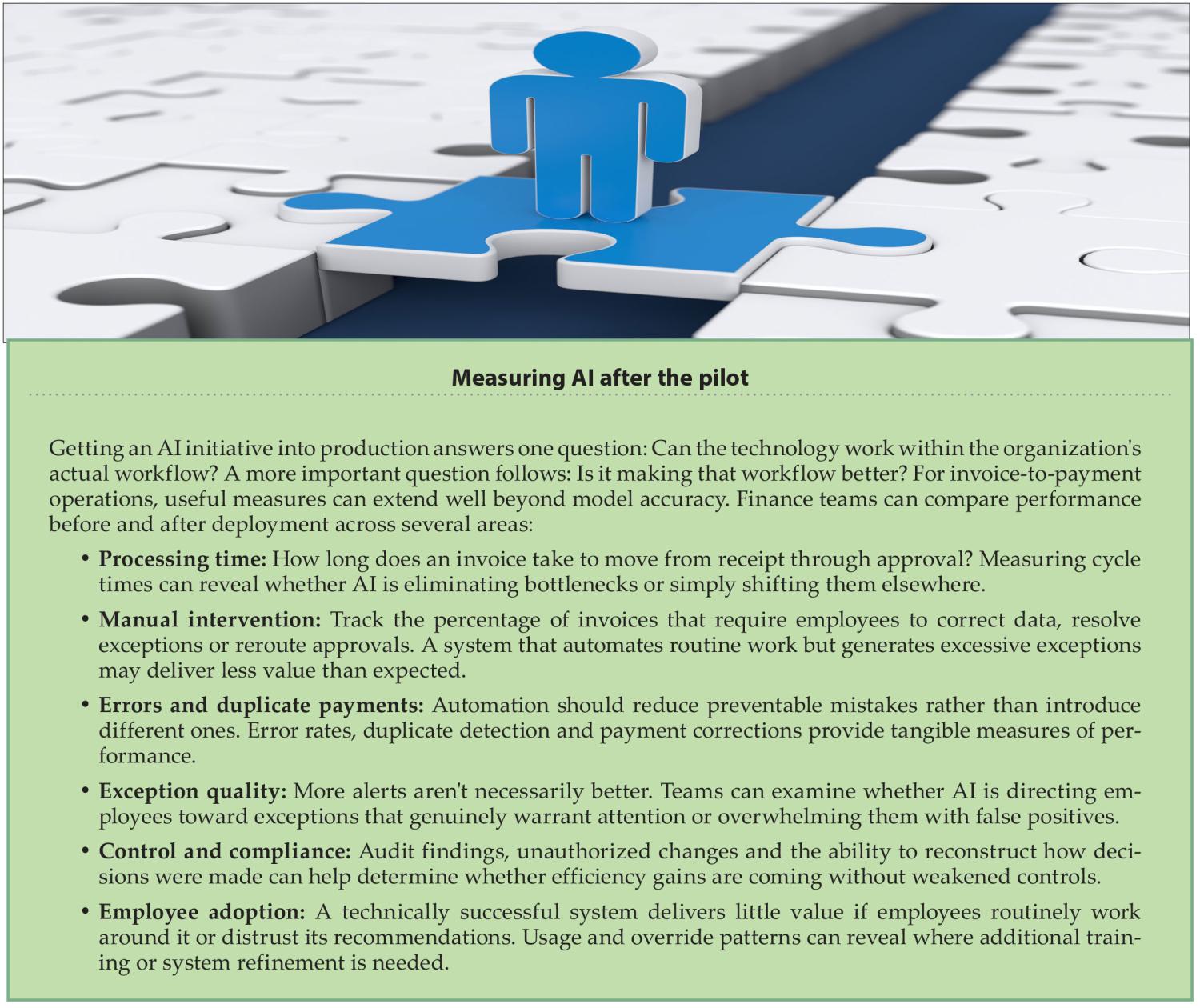
Another pitfall is assuming the work ends at deployment, when in fact that's where it begins. Sustaining value requires continuous iteration. AI models must evolve alongside the business through ongoing monitoring, tuning and refinement as processes and operating conditions change.
As organizations focus on deploying and scaling AI, one critical factor is often overlooked: the people who will actually use it. Even strong AI tools will struggle to gain traction if users don't understand when to trust the technology, when to challenge it and how exceptions should be handled. The result is a tool that exists in theory, but not in day-to-day operations.
Moving beyond the middle stage of AI maturity requires more than building the technology. Organizations must create the conditions for AI to adapt as business requirements change and become embedded in the invoice-to-payment processes finance teams rely on every day.
Four pillars for turning AI into an operational capability
The transition from pilot to production starts with a strong foundation. These four priorities can help Finance teams turn AI experimentation into a reliable operational capability.
- Get your processes in order
Before expanding AI across invoice-to-payment operations, organizations need a clear picture of how those workflows function today. Start by mapping the process from invoice intake to payment approval and identify where delays, manual rework, unclear ownership or exception backlogs are creating friction.
This step matters because AI will only accelerate whatever process it's placed into. If approval paths are inconsistent, supplier records are incomplete or exceptions are handled differently each time, automation won't magically solve those problems — it'll simply move those problems through the workflow faster.
Once those gaps are visible, strengthen the foundation beneath them. Clean ERP and supplier data, defined approval rules, governance expectations and clear audit trails give AI the structure it needs to operate safely and consistently.
- Start with high-volume, low-risk workflows
AI should first be applied where it can deliver clear value without compromising control. In invoice processing, that often means repetitive, rules-based tasks such as invoice data extraction, PO matching, approval routing, duplicate detection and exception flagging. These workflows are ideal starting points because they consume significant time but often don't require strategic judgment. Automating them can reduce manual work and provide better visibility into approval bottlenecks, payment timing and cashflow. As teams gain confidence in these lower-risk use cases, they can gradually expand AI into more complex workflows while maintaining the controls needed to manage risk.
- Define clear decision-making boundaries
Fraud prevention and review controls should be built into AI workflows from the start. Define which signals require review before payment approval, such as unusual invoice patterns, suspicious supplier or bank account changes, or vendor verification discrepancies.
At the same time, human oversight should remain firmly in place for exceptions and higher-risk decisions. This applies particularly when supplier records are modified, invoices are disputed or transactions raise fraud or compliance concerns.
By identifying risk before funds are released, AI gives teams a better opportunity to investigate and prevent costly errors from moving further through the payment process.
- Establish ownership and accountability
AI initiatives need clear ownership, starting with an executive sponsor or AI champion. This person understands both the technology's potential and the reality of day-to-day invoice and payment operations, allowing them to identify where automation is appropriate and where human control must remain.
Ownership can't sit with one person alone, however. Leaders should provide sponsorship and support so AI doesn't remain an isolated experiment. And as AI becomes more deeply integrated across finance systems, treasury platforms and operational workflows, this accountability will only become more important.
Taking AI from pilot to production
For organizations that feel stuck between experimentation and operationalization, the answer is not to add more tools. It's to strengthen processes, clarify ownership and take a deliberate approach to where AI can deliver value and where human judgment should remain in control.When those foundations are in place, AI shifts from an experiment to a dependable business capability that supports the workflows, decisions and controls that keep finance operations moving. 
Jean-Jacques Bérard is chief product and technology officer at Esker. In this role, he implements product strategy and oversees product planning and development. Jean-Jacques joined Esker in 1995 as project leader for the SQL team and later moved to research and development manager in 1997. In 1998 he advanced to his current role. Prior to Esker, Jean-Jacques was R&D team manager at Arthur Andersen Consulting in Lyon. Contact him via LinkedIn at linkedin.com/in/jean-jacquesberard.
Notice to readers: These are archived articles. Contact information, links and other details may be out of date. We regret any inconvenience.
