




The Green Sheet Online Edition
August 24, 2026 • 26:08:02
How AI and LLMs will transform payment gateway technology
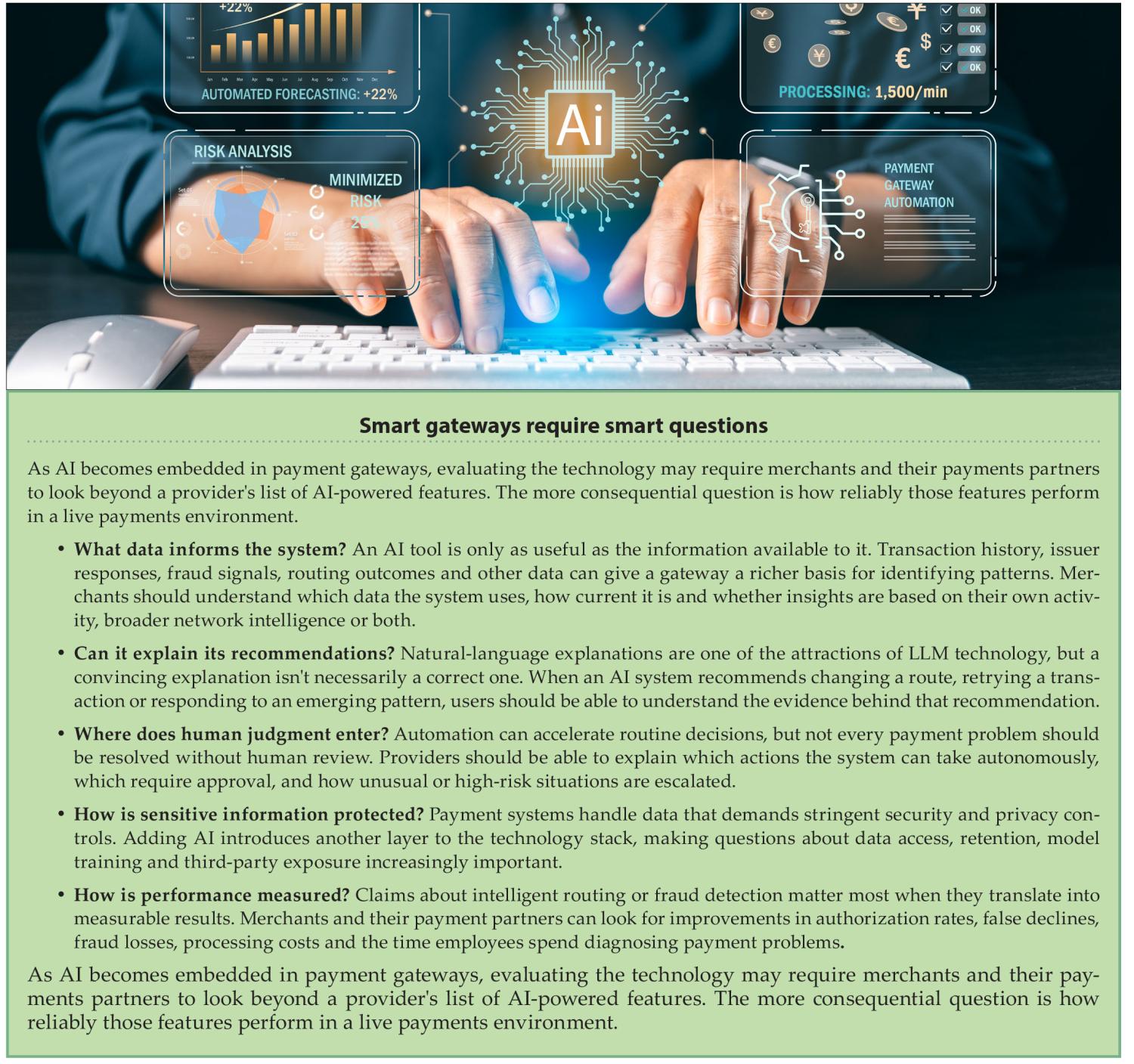
For years, artificial intelligence (AI) in payments was treated as a horizon technology, something to watch rather than deploy. That era is now over. According to a major 2025 industry report by HCL Tech (see tinyurl.com/ysbsw2md), 99 percent of organizations are now using AI in payment operations, and 52 percent expect to become fully autonomous financial service providers within the next 18 to 24 months.
These colossal figures reflect a structural shift already underway across the global payments landscape, one that's rewriting the expectations merchants, acquirers, and processors have of the technology sitting between them and their customers.
The payment gateway, long regarded as a reliable but unglamorous piece of infrastructure, is at the centre of this transformation. Gateways have historically served a narrow function: route the transaction, return an authorization code, pass the result back. But this model was built for a simpler era.
Today's payments environment demands far more. Merchants need real-time intelligence on why transactions are declining, how their acceptance rates compare across markets, where fraud risk is concentrating, and what they can do about any of it before the next payment attempt arrives.
The gateway that merely processes is being replaced by the gateway that thinks.
Why LLMs change the equation
The emergence of large language models (LLMs) as a practical business tool has introduced a capability that earlier AI architectures could not easily provide: the ability to interpret complex, high-dimensional data and surface it in natural language that non-technical users can act on immediately. This is the distinction that matters most for payments.
Traditional machine learning (ML) models have long been applied to fraud scoring and transaction routing, and they've delivered genuine value. Mastercard's Decision Intelligence Pro, built on a generative AI recurrent neural network, can scan 1 trillion data points and has improved fraud detection rates by an average of 20 percent, reaching as high as 300 percent in certain cases, while reducing false positives by more than 85 percent (see tinyurl.com/7bdkese).
A separate Mastercard generative AI system focused on compromised card detection doubled its identification rate and increased the speed of flagging at-risk merchants by 300 percent (see tinyurl.com/4mfdww3r). These are the kinds of operational outcomes that drive boardroom conviction.
But pure ML models, however powerful, are opaque. They produce scores and signals; they do not explain themselves in language that a merchant's operations team can digest and relay to their finance director or customer service staff. And LLMs change this fundamentally.
By sitting on top of transaction data, risk signals and decline codes, an LLM layer can translate raw outputs into actionable plain-language explanations. A gateway augmented with LLM capability can tell a merchant not just that a transaction failed but why, which bank issued the decline, whether the pattern is recurring, and what remediation is available. This closes the intelligence gap between data and decision.
Stripe, which unveiled what it described as the world's first AI foundation model for payments at its annual Sessions event in May 2025, has moved particularly aggressively in this space. The company built its agent toolkit to allow LLMs to interact directly with payment functions through natural language calls, integrating with OpenAI's Agents SDK, LangChain and other major frameworks.
Stripe's developer documentation explicitly frames LLM integration as the new architecture for intelligent payment workflows, enabling capabilities that range from dynamic routing to automated financial reconciliation.
The competitive advantage is real, and it's widening
For merchants operating at scale, the business case for AI-enriched payment gateways has moved well beyond theory. Acceptance rate optimization is perhaps the most direct financial benefit. Every declined transaction that could have been approved represents lost revenue.
By using AI to analyze issuer behavior, card type, geography and transaction context simultaneously, an intelligent gateway can route transactions across acquiring paths with higher probabilities of approval. Over thousands of daily transactions, even small improvements in acceptance rates accumulate into meaningful revenue recovery.
The competitive pressure to adopt these capabilities is being amplified by the behavior of the networks themselves. Visa and Mastercard both launched agentic AI payment frameworks in the latter part of 2025, with Visa's Trusted Agent Protocol attracting partners including Stripe, Shopify, Worldpay, Microsoft, OpenAI and Anthropic.
PayPal and Mastercard subsequently deepened their partnership to advance agentic commerce, targeting hundreds of millions of consumers and tens of millions of merchants.
When the largest networks in the world are restructuring their protocols around AI-native interactions, a gateway without AI capability is not just behind the curve; it's operating in a framework that was not designed for it.
How merchants benefit in practice
The value of LLM-powered gateway technology flows to merchants across three distinct dimensions. The first is operational clarity. Instead of receiving opaque decline codes that require a technical specialist to interpret, merchant teams receive natural language explanations that can inform immediate action, whether that means requesting a card retry, updating payment credentials or identifying a systemic routing issue.
The second dimension is strategic intelligence. An LLM layer trained on a merchant's transaction history can surface trends in real time, flagging performance deterioration across specific card types or geographies before it becomes a material problem. This kind of proactive insight was previously the preserve of merchants large enough to employ dedicated payments analysts. AI-powered gateways democratize access to it.
The third dimension is resilience. As fraud tactics evolve and regulatory requirements grow more complex, an AI infrastructure that learns from new signals and adapts continuously outperforms one locked to static rules. The merchants best positioned in the payments landscape of 2026 and beyond will not simply be those with the highest transaction volumes. They will be those whose payment infrastructure is intelligent enough to improve itself.
The gateway is no longer just a conduit. It is becoming the most consequential piece of technology in a merchant's commercial stack, and the organizations that recognize this shift early will hold an enduring structural advantage over those that do not. 
Andrii Shevchuk is CTO and partner at CONCRYT, https://concryt.io. Contact him via LinkedIn at linkedin.com/in/andrii-shevchuk-53224645.
Notice to readers: These are archived articles. Contact information, links and other details may be out of date. We regret any inconvenience.
