




The Green Sheet Online Edition
August 24, 2026 • 26:08:02
Payments is looking for AI value in the wrong place
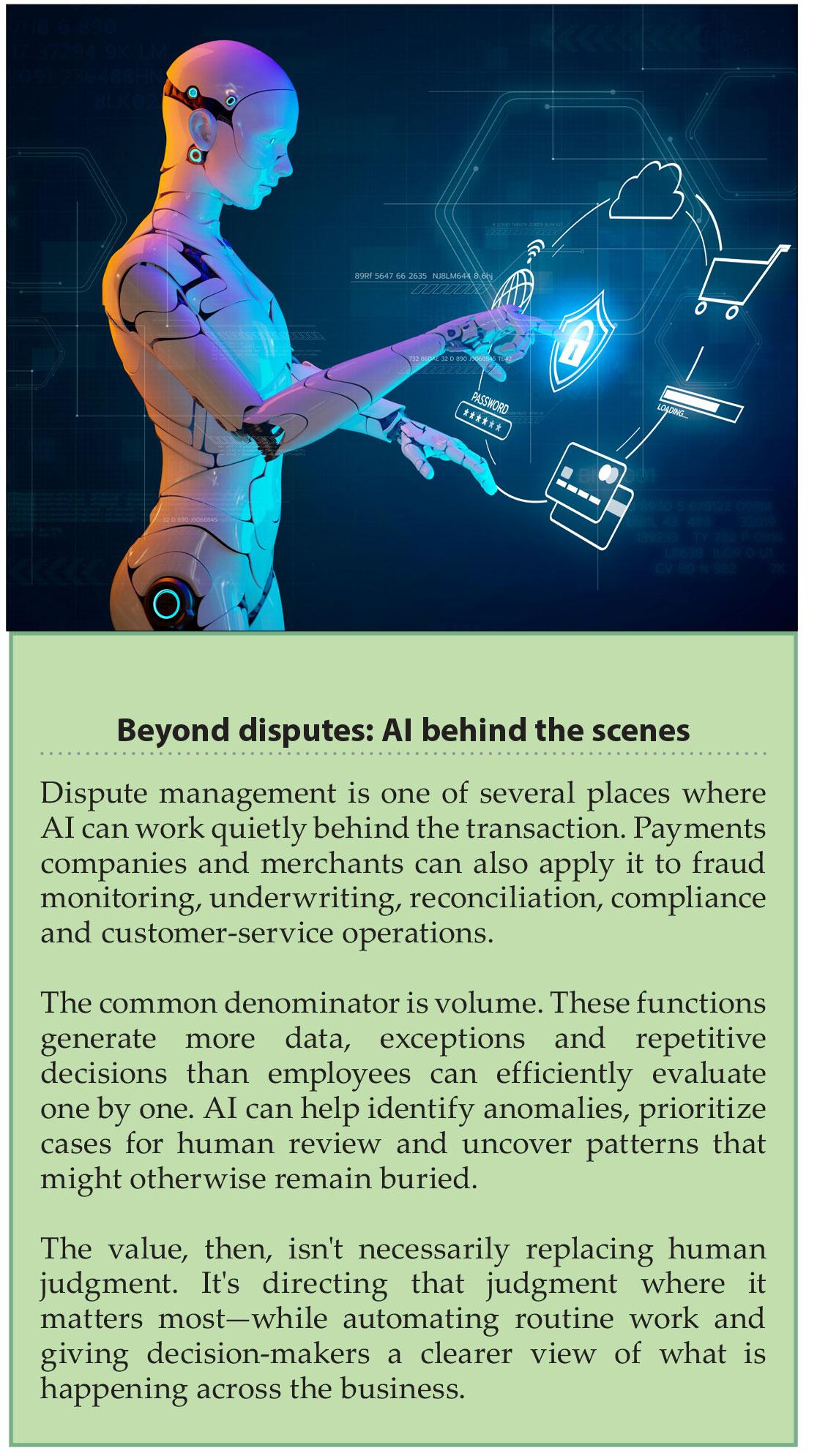
The payments industry has largely settled on a single AI narrative. The future belongs to the intelligent assistant, the personalized recommendation, the frictionless checkout, and the agent that completes a purchase before the consumer has finished forming the thought. Customer-facing AI is where the investment is going, where the narratives are loudest and where every major platform is racing to plant its flag.
But the industry is looking in the wrong direction. The FT Partners & BCG: Global FinTech Report 2026 - From Recovery to Resurgence (see tinyurl.com/yc66cffj) is one of the most closely read reports in financial services, and it contains an observation that many people have overlooked.
AI's strongest near-term gains are concentrated in operational and workflow-heavy domains, not fully autonomous consumer experiences. The firms seeing the most measurable value from AI are redesigning how internal work gets done: compressing cycle times, reducing manual workloads and generating real-time insight at a scale no human team can replicate.
The customer-facing revolution may be coming, but the operational revolution is already here.
Payments is overlooking its biggest AI opportunity
Global fintech revenues reached $504 billion in 2025. Every one of those transactions carries post-transaction risk. Chargebacks, friendly fraud and disputed transactions do not disappear because the front-end experience is seamless. In many cases, complexity increases as transaction volumes grow and new payment models emerge.
The question merchants should be asking is not simply how to accelerate growth. It is whether they have the insight needed to protect the revenue they generate. Most cannot answer that question confidently.
The majority of merchants operating at scale today lack the internal capability to independently analyze dispute activity in any meaningful way. They can see that disputes are occurring. What they struggle to understand is why those disputes are happening, where risk is concentrating, which trends are accelerating and how operational performance is changing over time.
They are generating enormous transaction volumes with limited visibility into the factors driving revenue loss. That is an intelligence gap, and it is precisely the type of challenge AI is already solving elsewhere across financial services.
The operational visibility gap
The report highlights where AI is creating measurable value today: compliance workflows, fraud operations, underwriting, engineering productivity and other operationally intensive functions. Dispute management belongs firmly in that category. Yet it remains largely absent from the industry's AI conversation.
The dispute lifecycle is full of repetitive, pattern-dependent and evidence-intensive work that is difficult to manage effectively through manual processes alone.
Identifying which disputes are likely to be won, recognizing emerging fraud signals, understanding the root causes of chargebacks and measuring performance across large transaction portfolios all require a level of visibility that many organizations simply do not have.
Many merchants lack the internal tools or expertise needed to generate this level of insight independently and therefore rely on third-party providers to bridge that gap.
As dispute environments become more complex, continuously measuring performance and responding to real-time feedback is becoming a competitive necessity rather than an operational advantage.
Agentic commerce raises the stakes
The report also points to the emergence of agentic commerce, where AI systems increasingly assist with product discovery, purchasing decisions and transaction execution. Much of the discussion around agentic commerce focuses on convenience and efficiency. Those benefits are real. But from a merchant perspective, agentic commerce also highlights why operational visibility matters.
As transactions become more sophisticated, merchants need a clearer understanding of what is happening throughout the customer journey and how those changes affect dispute activity, fraud patterns and revenue recovery.
When AI systems become more involved in purchasing decisions, questions related to authorization, accountability and dispute resolution inevitably become more complex. Existing frameworks were built around traditional transaction behaviors. New commerce models will introduce new challenges that merchants must be prepared to identify and manage.
The organizations with strong operational intelligence will be far better positioned to adapt. But those relying on fragmented reporting and reactive processes will struggle. As I often tell merchants: you cannot manage what you cannot see.
Turning insight into action
This is the AI opportunity the payments industry continues to underestimate. Not the assistant at the front of the customer journey but the intelligence engine operating behind every transaction.
AI and machine learning are increasingly capable of identifying patterns, surfacing emerging risks, reducing manual workloads and helping organizations make faster, better-informed decisions. In dispute management, those capabilities are particularly valuable because they address a challenge many merchants still struggle to solve independently: turning vast amounts of transaction and dispute data into actionable insight.
The outcomes are measurable:
- Improved dispute win rates
- Actionable insights
- Increased authorization rates
- Reduced manual workloads
- Better visibility.
These results come from treating dispute intelligence as an operational intelligence challenge.
Where payments should focus next
The industry is focused on growth, AI and new commerce models and it should be. But the merchants that thrive over the next decade will not simply be the organizations deploying the most sophisticated customer-facing technology. But those that can see, measure and improve performance in real time.
They will understand why disputes are happening, where risks are developing and what actions produce measurable results. That is where AI is already creating value today and that is also where operational intelligence becomes a competitive advantage. Because in payments, growth matters but understanding what happens after the transaction matters just as much. 
Monica Eaton is the founder and CEO of Chargebacks911 and Fi911, as well as Chief Information Officer of Global Risk Technologies. Monica has worked tirelessly to educate merchants and financial institutions about hidden threats in the rapidly changing payment fraud landscape. For more information, visit www.chargebacks911.com, https://fi911.com/ or reach out via LinkedIn at linkedin.com/in/monicaeatoncardone.
Notice to readers: These are archived articles. Contact information, links and other details may be out of date. We regret any inconvenience.
