




The Green Sheet Online Edition
June 8, 2026 • 26:06:01
ACH modernization drives multi-rail payments transformation
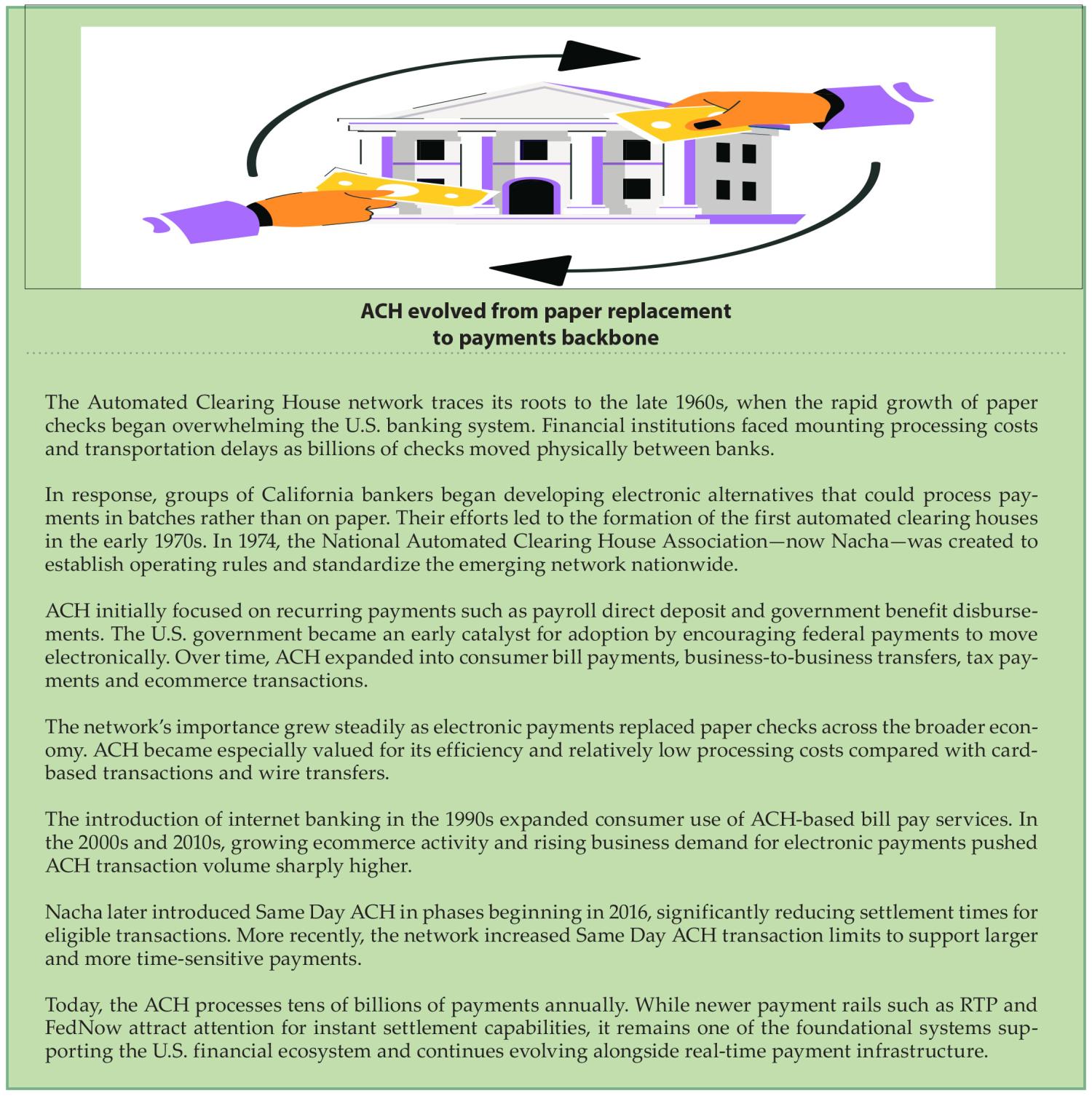
U.S. payments modernization is increasingly shaped by emerging payment technologies, while the foundational systems that continue to carry the majority of transaction volume receive comparatively less emphasis. While attention shifts to real-time rails and digital money innovations, ACH continues to quietly anchor the majority of U.S. payment flows.
With FedNow, RTP and broader digital asset models expanding, this direction is understandable. Yet one payment rail remains systematically undervalued, despite shouldering some of the most critical and highest-volume transactions in the financial system.
ACH remains the workhorse of the U.S. payments ecosystem, still carrying the bulk of payment volume across the country and continuing to expand. It is growing at ~5 percent year-on-year in volume and ~8 percent year-on-year in value, reinforcing both its scale and ongoing relevance within the evolving payments landscape (see tinyurl.com/nhavdrup).
Why legacy infrastructure is becoming a strategic constraint
Legacy ACH infrastructures have become active constraints on scale, resilience and execution. These constraints include:
- Legacy infrastructure: While useful for traditional payment cycles, many legacy ACH systems were not designed to support instant payments alongside batch ACH without significant re-architecture. High operational dependency and manual touchpoints: End-to-end ACH workflows still require significant manual intervention for file handling, exception processing and reconciliation, reducing straight-through processing efficiency.
- Capacity bottlenecks: While capable of handling large volumes, legacy ACH systems lack the flexibility to support new offerings such as enhanced operational UX, AI-driven exception handling, and evolving network requirements.
- Limited operational visibility and usability: Fragmented monitoring and non-intuitive user interfaces restrict end-to-end insight into transaction status, liquidity impact and exceptions, reducing operational efficiency and decision-making speed.
- Legacy system rigidity and modernization constraints: Deeply embedded legacy architectures and codebases make enhancements complex, risky and slow, limiting the ability to evolve without disrupting stable processing.
- Misalignment with modern bank operating models: ACH systems are built around legacy organizational constructs rather than today's product-centric, API-driven, and agile operating structures.
Left unaddressed, these constraints do not erode the stability or throughput of ACH systems, but they do limit banks' ability to innovate.
Banks will face constraints, including slower modernization, prolonged exception handling and reduced visibility into cash flow. These limitations will prevent financial leaders from making effective execution decisions because they lack transparency into the entire process.
At the same time, as ACH volumes continue to grow, processing complexity is pushed even further beyond the reach of aging systems. This growing demand widens the gap between legacy technology stacks and required capabilities, as customer expectations evolve with instant payments, ISO 20022 and AI.
Without modernization, the lack of updated payment technology will strain operations teams and exacerbate customer experiences.
With updated systems, banks directly address legacy limitations. They improve productivity, scalability and workflow control, positioning themselves for continued growth.
Modernizing ACH as a foundation for payments innovation
Delaying modernization means risking the ability to support new payment functions and financial services as the payments environment continues to advance.
But the banking industry should be careful about what it means by modernization. ACH itself is not standing still, with Same-Day ACH and expanded settlement windows having already moved the network beyond the way many banks still process it.
Nacha also recently approved an increase in the Same Day ACH per-payment limit to $10 million, further expanding the network's ability to support high-value, time-sensitive use cases (see tinyurl.com/mrpf336u). The problem is not that ACH is outdated, but many of the systems used to process it still are.
This is where the deeper issue becomes clear: most banks do not lack payment functionality; they lack coherence across systems. ACH, RTP, FedNow and wire processing are often handled by separate systems, each with its own business logic, monitoring tools, exception queues and operational workflows.
That fragmentation introduces duplicated rules, inconsistent transaction handling, growing reconciliation complexity and more operational handoffs than banks realize. In practice, many financial institutions have not modernized payments at all. They have simply distributed the original problem across more systems and more teams.
ACH architecture must be designed to handle high transaction volumes with consistency and resilience, ensuring uninterrupted processing, even under peak load conditions. Given the scale of ACH file processing, the emphasis should be on meeting tighter SLAs for large batch submissions without disrupting downstream operations or settlement cycles.
A modern ACH platform should also support elastic scalability, automatically scaling up during high-volume windows and scaling down during idle periods to optimize infrastructure costs while still meeting strict processing requirements.
Operational efficiency is equally critical. AI-driven capabilities should be leveraged to reduce manual intervention in repetitive workflows such as Notices of Change (NOCs), reversals, returns handling and exception management. This shift not only improves accuracy but also enhances processing speed and operational resilience.
Finally, ACH modernization must enable a true multi-rail strategy. The architecture should allow banks to dynamically evaluate and shift payments between ACH, instant payment systems and wire rails based on cost, urgency and liquidity considerations.
This positions ACH not as a standalone batch rail, but as part of an integrated payments ecosystem that can intelligently route transactions and identify opportunities to migrate eligible flows toward instant payments where appropriate.
Building infrastructure for next-generation payments
ACH has long delivered what modern systems still strive for: flexibility through multiple SEC codes, support for both credit-funded and prefunded models, flexibility of same day and next day ACH, and seamless integration with enterprise systems. But ACH is foundational. In a world shaped by instant payments, high-value rails like Fedwire Funds Service and CHIPS, and global networks like SWIFT, the future doesn't belong to any single rail. It belongs to financial institutions that can orchestrate across all of them based on business needs and ensure interoperability. That's where ACH proves its enduring value, combining scale, resilience through always-on architectures, and cost efficiency through elastic infrastructure—thus serving as the backbone of a true multi-rail strategy, alongside real-time capabilities like FedNow.
The next generation of payments won't be defined by speed alone, but by intelligence; where systems dynamically determine how money should move based on context, cost and liquidity. The goal is not to choose between rails, but to make them work together: seamlessly, intelligently and at scale. Because the banks that get this right won't just move money faster; they'll move it smarter.
Maharaja Subramanian (MS) is senior director and head of product management for the Americas at Volante Technologies. With over 20 years of experience in payments modernization and banking technology, he has spent the past four years driving product strategy and innovation at Volante. Prior to Volante, he spearheaded payment modernization initiatives across APAC, Europe, and North America for Global Banks. He is passionate about shaping the next generation of AI-driven payment infrastructures and stablecoin-based ecosystems. To contact Maharaja on LinkedIn, see https://www.linkedin.com/in/maharajasubramanian/.
Notice to readers: These are archived articles. Contact information, links and other details may be out of date. We regret any inconvenience.
