




The Green Sheet Online Edition
April 27, 2026 • 26:04:02
Online healthcare commerce: A prescription for risk?
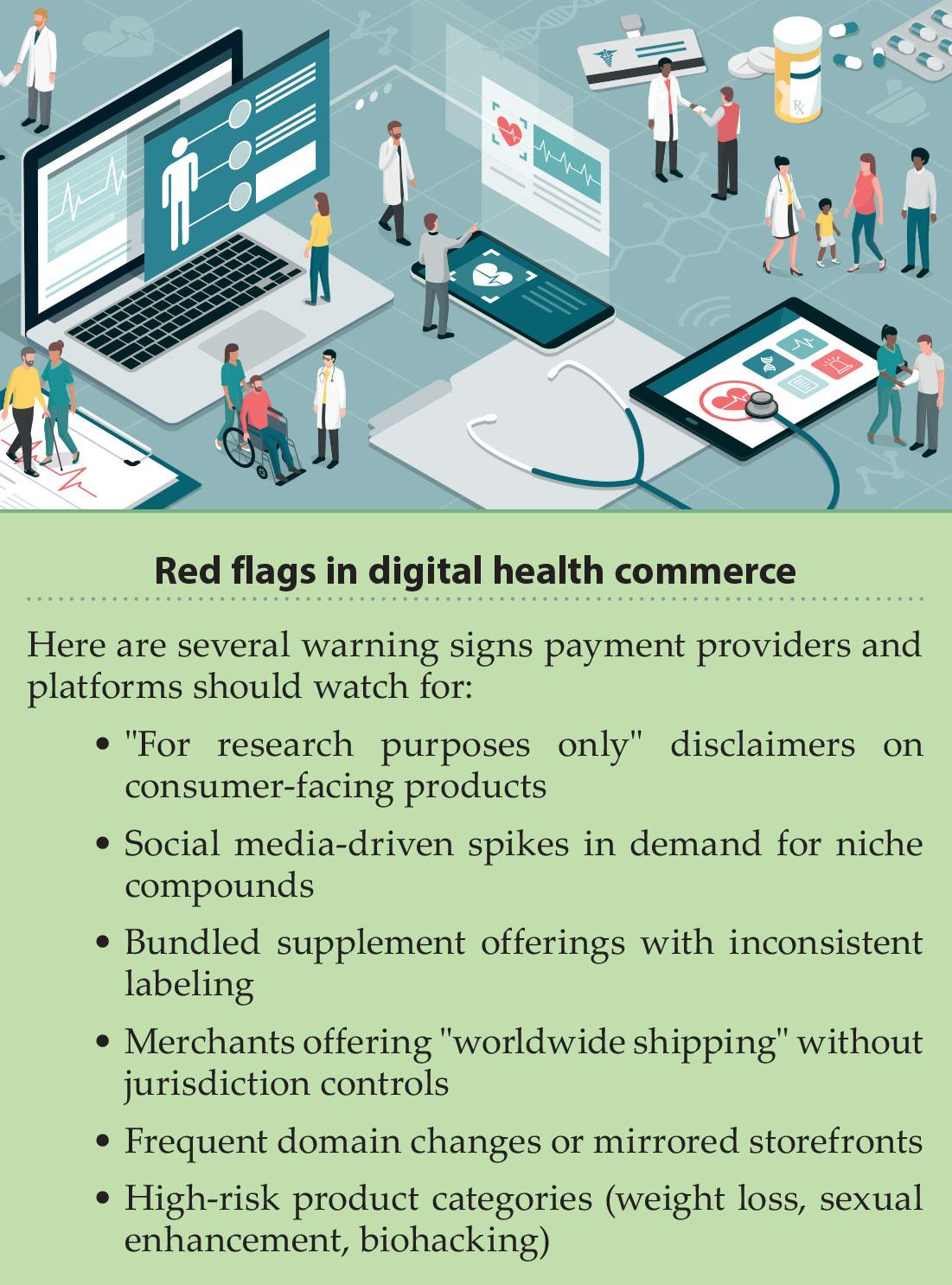
The digital health economy is booming. Telehealth platforms, online marketplaces, and cross-border fulfillment networks have made it possible to obtain everything from prescription medications to dietary supplements with a few clicks. However, that convenience has also led to rapidly rising risk for platforms and payment providers. At the intersection of e-commerce and consumer demand for wellness products, a complex threat landscape is taking shape. Surging demand for GLP-1 weight loss drugs, psychoactive compounds, and tainted supplements is creating opportunities for illicit sellers to exploit gaps across e-commerce, payments, and regulatory systems.
For these reasons, online healthcare commerce has become one of the most complex and consequential risk categories in digital commerce. Understanding the risks isn't just about compliance; it's about consumer safety.
Demand for wellness products is reshaping the threat landscape
At the center of the digital health risk landscape is a rising wave of consumer demand. For example, GLP-1 drugs, known under brand names such as Ozempic, Wegovy, Mounjaro, and Zepbound, have become one of the fastest-growing drug categories in history.
An estimated 12 percent of U.S. adults (see tinyurl.com/5fpaf7m4) have used some form of GLP-1 therapy, and global sales are projected to reach $150 billion (see tinyurl.com/2k6dab8b) by the early 2030s. In addition, many Americans pay out of pocket, making these drugs particularly attractive to digital-first sellers. An entire ecosystem has emerged around demand for these drugs. Direct-to-consumer tele-health models, compounding pharmacies, and med spas sit adjacent to traditional brick-and-mortar clinics and pharmacies. As access to GLP-1 medications expands, regulators have increased enforcement actions against violative models, developments that directly affect e-commerce platforms and payment service providers. At the same time, rising demand has created new opportunities for illicit sellers. For example, "peptide" merchants were once niche operators catering largely to bodybuilders. Now, they market products—including GLP-1 drugs and popular "biohacking" compounds like BPC-157—directly to mainstream consumers.
These products are often labeled "for research purposes only" and "not for human consumption," disclaimers intended to sidestep regulatory scrutiny. In practice, however, regulators assess such products based on how they are marketed and used. Many peptide sellers openly pitch their products for consumer use—through social media advertising, influencer marketing, and online forums—despite the disclaimers on their labels.
Key areas where risk hides
The challenge doesn't just lie in identifying known bad actors. E-commerce and payment services professionals must gain a big-picture understanding of where and how risk manifests before they onboard sellers.
Here are some of the critical areas identified by risk analysts:
- Potentially tainted supplements: Supplements containing undeclared substances are a global problem. When tested by regulators, many products are found to contain potentially dangerous, or even prescription-only, ingredients. Certain categories of supplements, such as those marketed for sexual enhancement, weight loss or bodybuilding, are particularly prone to issues.
When consumers purchase supplements, they often think they are taking something natural. In reality, some products marketed as supplements may contain prescription-only ingredients, sometimes at doses several times higher than approved drugs. For example, the FDA flagged more than two dozen honey-based products (see tinyurl.com/2tdhy6xm) for containing hidden drug ingredients (such as sildenafil and tadalafil, the active ingredients in Viagra and Cialis).
As with other high-risk supplements, social media attention and word-of-mouth can accelerate demand, even when consumers do not realize what they are ingesting (see tinyurl.com/45n4zdyf). The challenge is that tainted products often appear alongside otherwise legitimate inventory. A single high-risk supplement may be sold by a third-party merchant on a large marketplace or bundled into a site that otherwise falls within acceptable risk tolerance.
This makes it less an isolated product problem and more a pattern-recognition challenge. It requires e-commerce platforms and service providers to detect more sophisticated risk signals, even beyond product names.
- Cross-border complexity: A major challenge in online health commerce is variability of regulation: what's legal in one jurisdiction can be a controlled substance or prescription-only drug in another. The risk calculus changes dramatically based on a product's destination.
Merchants offering "worldwide shipping" on large supplement inventories are potentially selling products restricted somewhere in their shipping range. Ingredients common in U.S. supplements, such as DHEA, yohimbine and melatonin, require prescriptions in multiple countries.
Ecommerce platforms and payment providers must account for these differing regulations when assessing risk for cross-border merchants. The US is a major global supplement producer, but ingredients commonly sold in U.S. supplements may be prohibited in other jurisdictions.
- Emerging compounds and psychoactive substances: Emerging and psychoactive compounds are areas where future risk is likely to intensify—and it's moving fast. Compounds such as 7-OH, kratom, and psychoactive mushrooms have caught the attention of regulators for the potential risks to consumer health, but they are still actively sold online.
7-hydroxymitragynine (7-OH) has become a particularly hot topic recently. On July 29, 2025, the FDA recommended a scheduling action to control 7-OH under the Controlled Substances Act, warning of the potential for abuse and harm (see tinyurl.com/kp26ez9u). The FDA has also noted that 7-OH is far more potent than morphine (see tinyurl.com/yc26k82r).
Because there is currently no federal ban in the United States, 7-OH products remain widely available online, often sold as inexpensive tablets and gummies.
What ecommerce platforms must do now
The reality for ecommerce platforms and professionals is that healthcare-related risks are now embedded across wellness, beauty, supplements, and lifestyle commerce. The use cases aren't always obvious. In fact, bad actors will go great lengths to hide illicit online sales, disappearing and reappearing across platforms, and using sophisticated techniques such as front sites and transaction laundering.
Digital commerce platforms and payment providers sit on the front lines. They see merchants before regulators do, which means they have both the power and responsibility to cut off access to dangerous products and protect consumers.
Practical steps to take include:
- Gain deeper visibility into your merchants. Risk evaluation can't be static or superficial. After a comprehensive risk assessment at onboarding, merchants must be regularly reassessed. Businesses that were low-risk years ago may now ship products that materially change their (and your) risk exposure.
- Monitor warning signals. Effective risk management requires continuous monitoring. Things like bundled products, red-flag phrases, and social media-driven demand spikes can reveal potential violations long before regulators intervene.
- Evaluate cross-border shipping practices. Platforms must understand not just what is being sold, but where it is being shipped, and whether those products are lawful in destination jurisdictions.
A front-line responsibility
The online wellness commerce landscape is evolving faster than any single regulatory body can address. Consumer demand is creating enormous market pressure, while fragmented global regulation creates gaps that can be exploited. If that weren't enough, the speed of digital transactions allows bad actors to move products faster than traditional enforcement can respond.
As the risks continue to migrate into mainstream ecommerce, platforms and payment providers increasingly serve as the first line of defense. They often see emerging threats before regulators do. It's no longer a niche concern, but a core commerce risk that demands proactive oversight and informed action. 
Niamh Lewis is the vice president of compliance operations at G2 Risk Solutions. Contact her at niamh.lewis@g2risksolutions.com.
Notice to readers: These are archived articles. Contact information, links and other details may be out of date. We regret any inconvenience.
