




The Green Sheet Online Edition
April 13, 2026 • 26:04:01
AI shopping expands into instant credit
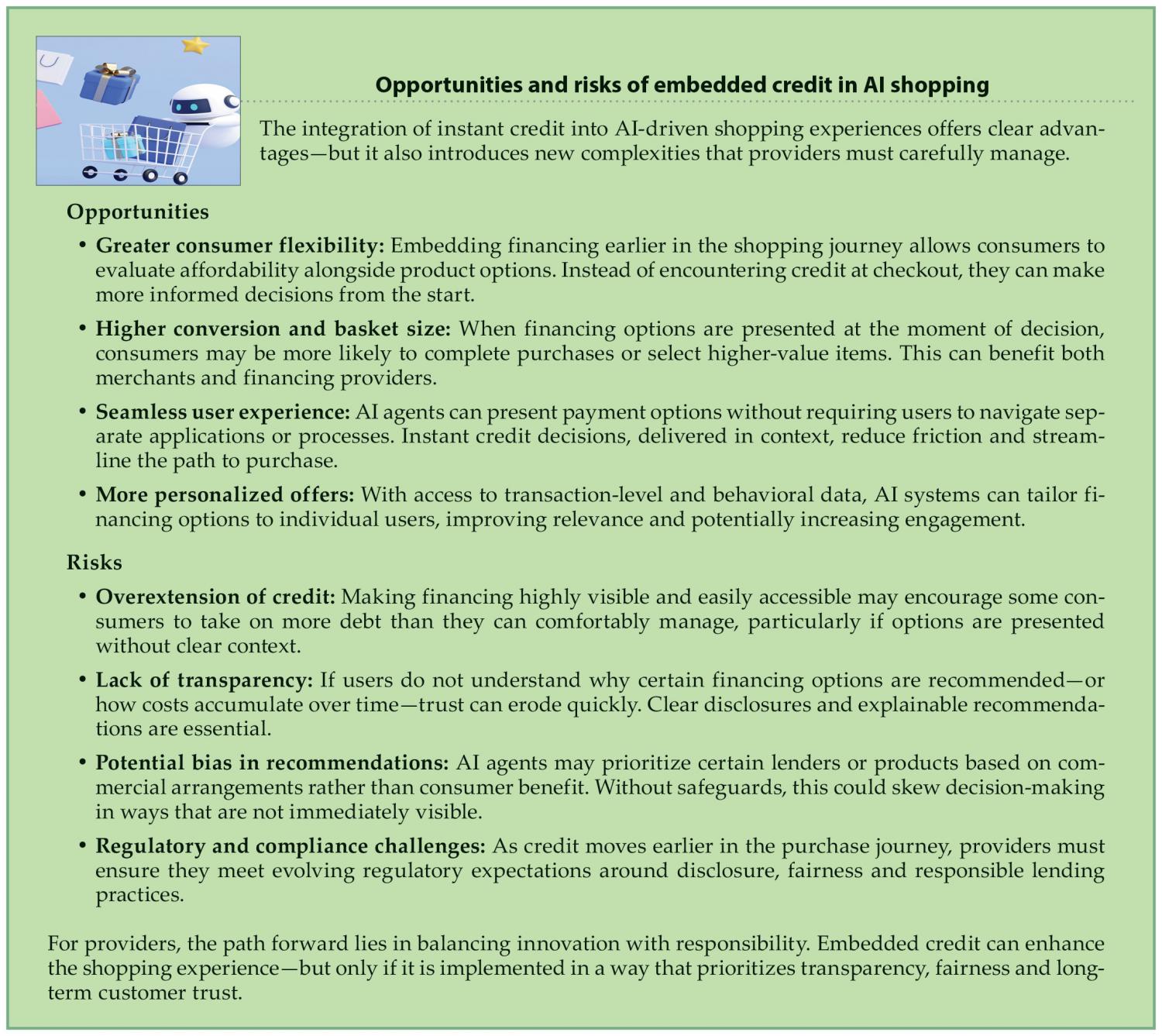
Artificial intelligence is rapidly reshaping how consumers discover, compare and purchase products online. Over the past year we have seen a surge in AI-powered shopping assistants capable of searching across retailers, curating personalized recommendations and even completing purchases on behalf of consumers.
The next phase of this evolution is now emerging: the integration of instant credit directly into AI-driven shopping journeys.
Recent developments enabling buy now, pay later (BNPL) within AI-led shopping experiences signal an important shift for what is increasingly being called agentic commerce. In this model, intelligent agents do more than surface product suggestions.
They actively guide purchasing decisions, compare options and execute transactions. Integrating financing into this flow has the potential to fundamentally change how consumers evaluate affordability and make purchasing decisions.
Moving credit earlier in the purchase journey
Historically, financing options were introduced at the end of the checkout process. Consumers would select a product, proceed to payment, and then be presented with options such as BNPL or installment plans.
AI agents change that dynamic.
Instead of appearing as a last-minute payment method, credit can become part of the conversation earlier in the purchase journey. For example, when a consumer asks an AI assistant to find a laptop within a certain budget the agent could present multiple options alongside contextual financing suggestions. It could say, for example, you could pay in full today, split this into three interest-free payments or choose a six-month installment plan.
This seemingly small shift has significant implications. When financing becomes part of product discovery rather than checkout it influences how consumers evaluate price, value and affordability. In other words, credit becomes a decision-support tool rather than simply a payment mechanism.
Why BNPL is well-positioned for agentic commerce
BNPL providers are particularly well-suited to this environment because their products are already designed for speed, simplicity and point-of-purchase decisioning.
Over the past decade BNPL platforms have built underwriting systems capable of delivering instant credit assessments with minimal friction. These systems analyze transaction-level data in real time allowing approval decisions to happen within seconds.
When combined with AI shopping agents, that infrastructure becomes even more powerful. An agent can compare multiple products, evaluate pricing and present tailored financing options instantly. The consumer does not need to navigate separate payment flows or apply for credit independently. Instead, the financing option is surfaced at the moment it becomes relevant.
For fintech providers the strategic goal is clear: to be embedded within the AI shopping journey itself rather than appearing only at checkout.
Expanding consumer choice
Until recently most AI-powered shopping agents have defaulted to a relatively simple payment model: using a card already stored on file. While convenient, this approach limits the range of financial options available to consumers.
Integrating instant credit expands that choice.
An AI agent that can present multiple payment methods including full payment, installments or BNPL allows consumers to make more informed decisions about affordability. For some purchases, the ability to spread payments may make a product accessible that would otherwise be out of reach.
This capability also changes the economics of online retail. Merchants benefit from higher conversion rates and larger average basket sizes when financing options are available at the moment of decision. From the consumer perspective, however, the key benefit is flexibility.
A new competitive landscape
The rise of agentic commerce could also reshape competition within the payments ecosystem. BNPL providers have already built strong positions at checkout in many digital commerce environments. By integrating directly into AI shopping flows they extend that influence further upstream in the purchase journey.
At the same time this shift could create new opportunities for traditional card issuers.
Historically, card issuers have often entered the transaction process after purchase intent has already formed. AI-driven commerce may allow them to compete earlier in the decision-making process by offering installment options, promotional financing or personalized credit terms within the agent interface.
In this sense, AI agents could become an important battleground for financial product visibility. Providers that can integrate their credit products seamlessly into agentic platforms will gain an advantage in influencing purchasing decisions.
The importance of trust and transparency
Despite the potential benefits, the expansion of embedded credit within AI shopping experiences raises important questions around transparency and consumer protection.
If an AI agent is recommending financing options alongside products, consumers must trust that those recommendations are unbiased and clearly explained.
A system that appears to prioritize lenders’ interests over those of the shopper risks undermining confidence quickly. Consumers need to understand why certain credit options are being presented and how repayment terms affect the total cost of a purchase.
This becomes particularly important as AI agents gain greater autonomy in executing transactions. Transparency, explainability and responsible credit design will be essential to ensure that the technology enhances consumer choice rather than obscuring it.
Designing responsible credit experiences
For fintech providers and payment platforms the challenge is not simply to integrate financing into AI commerce environments but to do so responsibly.
Clear disclosure of repayment terms, visible comparisons between payment options, and safeguards against excessive borrowing will all be critical components of trustworthy AI-driven commerce.
The companies that succeed will likely be those that treat credit as a consumer decision tool rather than simply a conversion driver. When designed thoughtfully, embedded financing can help consumers plan purchases more effectively and manage their budgets with greater flexibility.
The next phase of digital commerce
AI-powered shopping agents are still in the early stages of development, but their potential influence on commerce is significant. By combining product discovery, price comparison, purchasing and financing within a single conversational interface they could fundamentally reshape the online shopping experience.
The integration of instant credit represents a key milestone in that evolution.
If executed well, agentic commerce could create a more seamless and informed purchasing journey. Consumers could evaluate products, understand affordability and complete transactions within a single intelligent interaction.
However, success will depend on striking the right balance between innovation and trust. The winners in this new environment will not simply be the companies that integrate credit into AI agents first. They will be the ones that design transparent consumer-focused financing experiences that genuinely support better purchasing decisions.
As AI continues to transform digital commerce, embedded credit will increasingly move from the margins of the checkout page into the center of the shopping conversation itself.

Chris Jones manages PSE Consulting's business and is well known in the UK and EU for his regular insights into payments innovation. He has spent the last 20+ years leading assignments for major clients during his time at PSE and Accenture. His specializations include customer proposition development, market entry strategies and enterprise value creation. Contact him via email at info@pseconsulting.com or on LinkedIn at linkedin.com/in/chrisjonespse. To learn more about PSE, a provider of payment advisory services to professionals across the payments landscape, visit https://pseconsulting.com.
Notice to readers: These are archived articles. Contact information, links and other details may be out of date. We regret any inconvenience.
