




The Green Sheet Online Edition
February 9, 2026 • 26:02:01
Resilient finance in an uncertain world
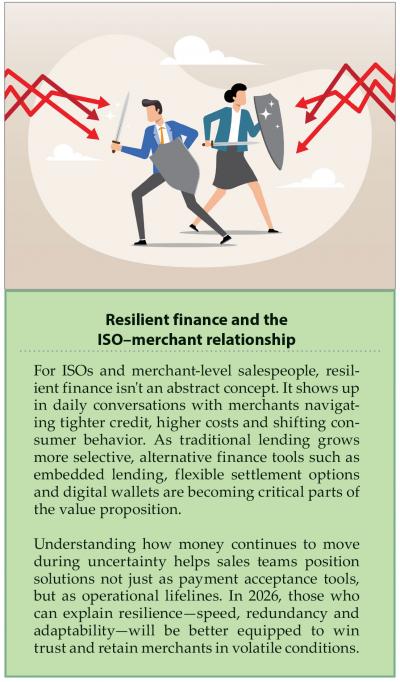
Economic stability is something most people think about only when it begins to fray. In calm periods, money moves quietly in the background: paychecks clear, businesses settle invoices, consumers swipe cards without thinking twice. During periods of uncertainty, however, the systems that keep money flowing suddenly come into focus.
In the United States, the Federal Reserve sits at the center of this stability. Its policies influence borrowing costs, credit availability, inflation and liquidity—not just domestically, but globally, given the central role of the U.S. dollar. Yet in recent years, another set of financial mechanisms has grown alongside the traditional system: alternative finance platforms, digital wallets, embedded lending and cryptocurrencies.
These systems are not replacing the Federal Reserve or the banking system. Instead, they increasingly operate as parallel rails, helping money continue to move when traditional channels tighten, slow down or become more selective. As economic volatility persists, understanding how these systems interact, and how alternative finance is likely to evolve in 2026, matters more than ever.
The Federal Reserve: The backbone of financial stability
The Federal Reserve's most visible role is managing interest rates. By adjusting rates, even marginally, the Fed can influence borrowing behavior, consumer spending, business investment and inflation. Rate decisions ripple through global markets, shaping everything from mortgage costs to foreign exchange flows. Behind the scenes, however, the Fed's responsibilities extend far beyond headline rate changes. It acts as a stabilizer for the banking system itself. Through facilities that provide short-term funding, the Fed ensures banks can meet payment obligations, process transactions and maintain liquidity during periods of stress. It also plays a critical role in maintaining large-scale payment infrastructure, ensuring that high-value transactions settle reliably.
During economic crises, or even periods of heightened uncertainty, the Federal Reserve's priority becomes preventing systemic failure. Bank collapses do not occur in isolation. One failure can cascade through payment networks, payroll systems, lending markets and consumer confidence. When banks face acute liquidity shortages, the Fed can step in with emergency funding, buying time for institutions to stabilize and preventing broader contagion.
The 2008 financial crisis demonstrated both the fragility of the system and the importance of centralized intervention. While the crisis was severe, it would likely have been far worse without a central authority capable of acting quickly and at scale. Stability, in this context, is not abstract; it determines whether people get paid, businesses receive funds, governments collect taxes and economies function at all.
The limits of centralization and rise of alternatives
At the same time, centralized systems have inherent constraints. Traditional finance relies on intermediaries: banks, clearinghouses and processors. If any of these institutions fail or restrict access, money can stop moving, sometimes abruptly.
Cryptocurrency and alternative finance emerged, in part, as a response to these limitations. Cryptocurrencies were designed to eliminate single points of failure by distributing transaction processing across decentralized networks. Instead of relying on a central ledger, transactions are validated across multiple nodes. If one fails, others maintain continuity.
Crypto transactions are peer-to-peer, with no intermediary bank required. This structure reduces bottlenecks and allows funds to move even when traditional banking access is limited. Because these networks are global by default, they also enable cross-border payments without relying on correspondent banking relationships.
That said, cryptocurrencies are not a replacement for traditional finance, nor are they likely to become one. They coexist with—and, in some cases, support—the existing system.
In periods of stress, they can absorb some pressure by providing alternative paths for payments and settlements. For cryptocurrencies to function effectively alongside traditional finance, they must meet several baseline expectations. Networks must be reliable and secure. Transactions must settle predictably. Users must have confidence that assets will not disappear due to technical failures. Volatility remains a challenge for some cryptocurrencies, though major networks have resolved many early operational issues.
Alternative finance expands in era of tight credit
As economic uncertainty persists, traditional banks tend to become more conservative. Credit standards tighten. Lending becomes more selective. This creates space for alternative finance models to grow.
Crowdfunding platforms, invoice trading, peer-to-peer lending and nonbank lenders have expanded steadily over the past decade. In times of volatility, their relevance increases. When businesses or individuals struggle to access bank financing, they often turn to alternative options that prioritize speed, flexibility or different risk assessments.
Market forecasts suggest the alternative finance sector will continue to grow significantly through 2026. Analysts have estimated the market would reach $9.8 billion this year, though many projections were made before recent technological acceleration. Given ongoing advancements, actual growth may exceed earlier expectations.
What distinguishes this expansion from previous cycles is not entirely new technology, but deeper integration of existing tools, particularly artificial intelligence, embedded finance and digital assets.
AI becomes core infrastructure, not a feature
Artificial intelligence is poised to play a central role in alternative finance development through 2026. Rather than serving as a novelty, AI is becoming embedded in core decision-making processes.
One of the most impactful applications is AI-powered credit assessment. Traditional credit scoring relies heavily on historical data and standardized metrics. AI models can incorporate broader behavioral signals, cash flow patterns and contextual data to assess repayment capacity more dynamically.
This shift could expand access to credit for individuals and businesses with limited or damaged credit histories but strong real-world financial behavior. At the same time, improved risk assessment can reduce default rates, lowering overall lending costs.
Beyond credit decisions, AI is being applied to fraud detection, transaction monitoring, pricing optimization and customer support. As these systems mature, alternative lenders may gain efficiency advantages that allow them to scale more rapidly than traditional institutions.
Tokenized assets and the push for efficiency
Regulatory pressures, particularly in regions like the European Union, are also shaping the future of alternative finance. Compliance costs and operational complexity have prompted some companies to explore tokenized assets as a way to streamline payments and cross-border activity.
Large players are already experimenting in this space. Klarna, for example, announced plans to launch a dollar-backed stablecoin aimed at simplifying international payments. PayPal introduced its own stablecoin as well. These initiatives seek to reduce settlement times, improve transparency and lower transaction costs compared to traditional banking rails.
Stablecoins occupy a hybrid space between crypto and traditional finance. While regulatory scrutiny is increasing, they often face fewer constraints than conventional banking products. If early implementations prove reliable, more companies may adopt similar models through late 2026 and beyond.
That said, tokenization remains in its early stages. Widespread adoption is unlikely to happen overnight. Initial use cases will probably focus on efficiency gains rather than radical restructuring of financial systems.
Embedded lending moves further into the background
For consumers, the most visible evolution in alternative finance will likely come through embedded lending. What once required a visit to a bank branch, or at least a standalone application, now happens seamlessly at the point of purchase.
Buy now, pay later (BNPL) models have become standard features in online checkout flows. By 2026, embedded lending is expected to expand beyond retail into services, subscriptions and business procurement. AI-driven risk assessment will increasingly determine eligibility in real time, often without users consciously engaging with a "loan" product.
This shift represents a broader trend: finance becoming invisible. Lending decisions happen instantly, payments route automatically and users interact with outcomes rather than infrastructure.
Centralized and decentralized systems, together
The future of money movement is not an either-or choice between centralized and decentralized systems. It is a layered ecosystem.
The Federal Reserve will remain the cornerstone of economic stability, ensuring banks remain solvent and payment systems function during stress. Alternative finance and cryptocurrencies, meanwhile, will continue to provide flexibility, redundancy and innovation at the edges.
In times of uncertainty, resilience matters more than purity of design. Systems that keep money moving, whether centralized or decentralized, play complementary roles. As 2026 unfolds, alternative finance will not redefine the financial system, but it will continue to reshape how people access credit, move funds and navigate instability.
That evolution, incremental but significant is already well underway.
Note: I used the following sources in researching this article:.
- www.federalreserve.gov/aboutthefed/fedexplained/who-we-are.htm
- www.globalgrowthinsights.com/market-reports/alternative-financing-market-104848
- www.reuters.com/business/finance/klarna-launch-dollar-backed-stablecoin-race-digital-payments-heats-up-2025-11-25/

Chad Otar is CEO of Lending Valley Inc. For information about the company, please visit www.lendingvalley.com. To reach Chad, send an email to chad@lendingvalley.com.
Notice to readers: These are archived articles. Contact information, links and other details may be out of date. We regret any inconvenience.
