




The Green Sheet Online Edition
November 9, 2026 • 26:11:01
Personalized pricing laws: How deterministic segmentation keeps merchant offers defensible
Jacki Kackert's Street SmartsSM article "A 2026 BFCM marketing playbook for your ISO or MLS business," in Green Sheet issue 26:09:02, (www.greensheet.com/emagazine.php?article_id=8049) made a good case for turning payment data into holiday marketing: help merchants sort customers into new, repeat, high-value and lapsed groups and tailor offers to each.
That advice makes sense. Before those offers go out, though, merchants need to know which data drives them and whether they can explain the difference, because the rules on using customer data to set prices changed this year.
On Oct. 1, 2026, Maryland began restricting how large grocery stores and their delivery partners use shoppers' personal data to set prices. New York has required a disclosure since November 2025: a business that sets a price algorithmically from a shopper's personal data must print "THIS PRICE WAS SET BY AN ALGORITHM USING YOUR PERSONAL DATA" next to it.
In August this year, the Federal Trade Commission proposed that businesses tell customers when a price is personalized, the basis for it and the types of data behind it.
Most merchants that run loyalty programs, targeted coupons or app-only prices have not followed these changes, and some of those offers run on data that passes through the payment stack. That makes personalized pricing relevant to ISOs and merchant level salespeople (MLSs), too, since a merchant that receives a letter from a state attorney general may well call the person who set up its processing first. What the new rules target The regulatory focus is not ordinary demand-based pricing, such as a restaurant that charges more on Friday night, because those changes apply to everyone. Surcharges, cash discounts and dual pricing, which set prices by how a customer pays rather than who the customer is, also fall outside it and remain governed by state surcharge laws and card network rules.
The FTC proposal is aimed at something different: two customers seeing different prices because of what the business knows about them.
No single state model has emerged, and the laws passed so far vary widely in who they cover. Maryland focuses on grocery stores of at least 15,000 square feet and the services that deliver for them. Connecticut goes further: its law, effective July 2027, can reach price differences applied to groups of customers as well as individuals.
Most of these laws exempt loyalty rewards and discounts open to any customer who meets the criteria, and for many merchants that distinction matters. A loyalty discount is easier to defend when eligibility is explicit and consistently applied.
Same offer, very different logic
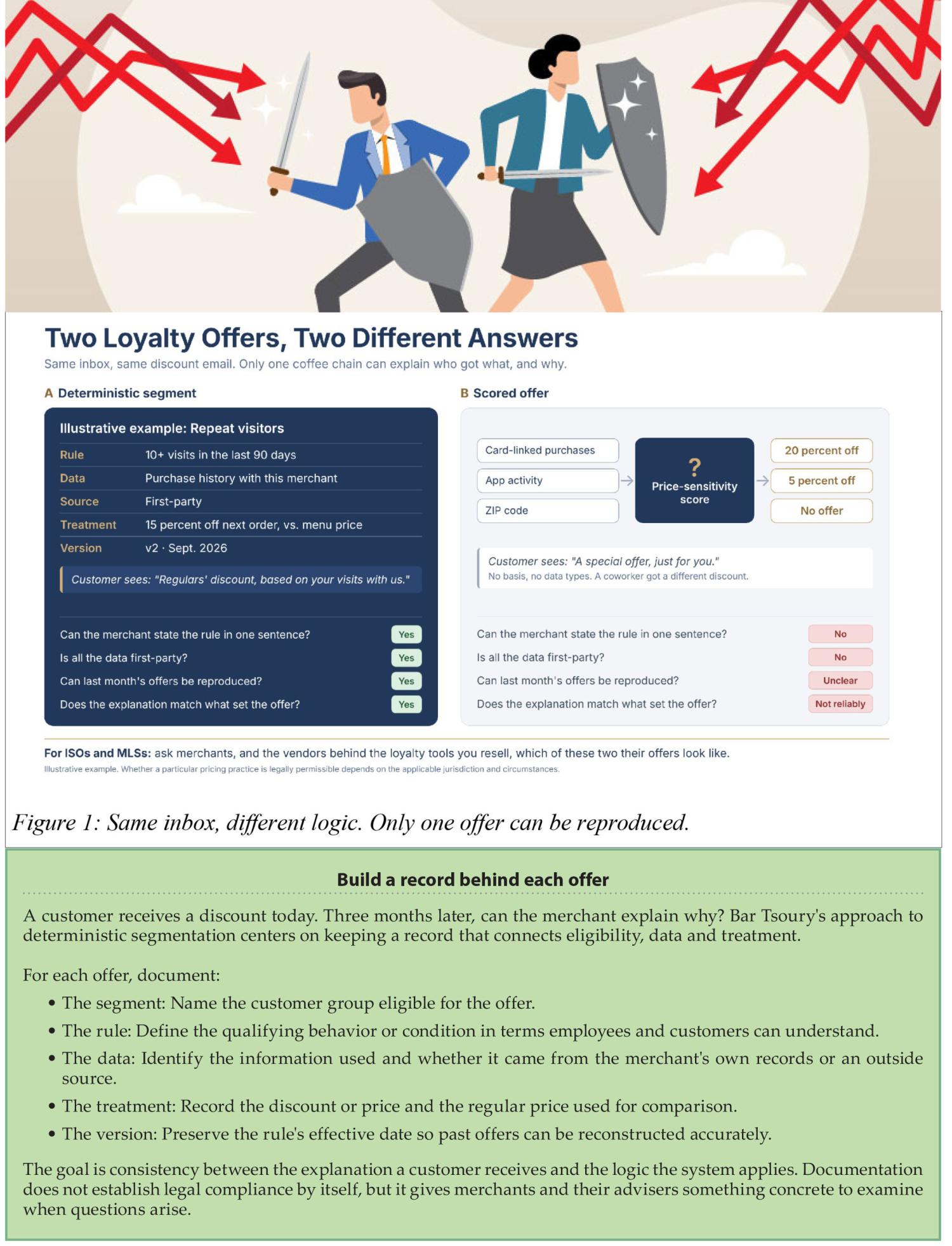
A coffee chain emails customers: "You've visited 10 times in the last three months. Here's 15 percent off your next order." Anyone who reaches 10 visits qualifies. The rule is blunt, since a regular on visit nine gets nothing, but it is written down, and the merchant can explain it without asking a data scientist to reverse-engineer a score.
A second chain uses a marketing platform that scores each customer's price sensitivity from visit history, card-linked purchases, app activity and ZIP code, then decides who gets 5 percent off, who gets 20 percent and who gets nothing.
Some of its offers end up looking a lot like the first chain's. If a customer asks why she got 5 percent when her coworker got 20 percent, though, the second chain may have no answer. The vendor may be able to show which variables influenced the score, but that is not the same as showing the rule that produced the offer.
The FTC proposal cites a similar case as deception: a "loyalty discount" that really reflects data about the customer's income or shopping habits.
How deterministic segmentation works
Deterministic segmentation assigns customers to defined, non-overlapping segments by explicit rules and ties each segment to a set price or offer, so the same inputs always produce the same result. Models can still help identify useful customer groups. The difference is that the model does not decide what one individual pays.
For the first coffee chain, the record behind the repeat-visitor offer would look something like this:
- Segment: Repeat visitors
- Rule: 10 or more visits in the last 90 days
- Data: Purchase history with this merchant (first-party)
- Treatment: 15 percent off the next order, compared with the regular menu price
- Version: v2, effective Sept. 1, 2026
That record matters months later, when somebody needs to reconstruct the offer, because it shows who qualified, which customer data was used, what discount applied and which version of the rule was active. Because the plain-English explanation to the customer and the pricing logic come from the same rule, what the merchant says and what the system did cannot drift apart.
Where payment data comes in
Payment and loyalty data, much of it flowing through processors and loyalty platforms, can reveal a detailed picture of customer behavior. First-party data creates fewer questions about provenance and consent than data purchased or inferred elsewhere. In a January 2025 Consumer Reports survey, 76 percent of Americans opposed loyalty discounts based partly on demographics such as age and income.
If an offer depends on third-party data, the merchant should know where it came from and whether customers agreed to that use, since the FTC proposal expects the business itself to verify consent for vendor data.
A bill in Congress would go further, limiting loyalty program data to running that program's discount or reward, which would reach many card-linked offers and loyalty add-ons that ISOs resell. The source should never disappear inside a score; a written rule identifies exactly which data was used.
Questions for your next merchant review
ISOs do not need to interpret the law for merchants, but they can ask whether a merchant knows how its different prices and offers are being determined. Five questions are enough to expose most of the problem:
- Do you offer different prices or discounts to different customers?
- Can you state the rule behind each offer in one sentence?
- What customer data does each offer use, and did any of it come from outside your business?
- If a customer asked why she got a particular price last month, could anyone answer from your records?
- If you resell loyalty or marketing software, can the vendor show the rule and data behind any offer it sent?
A no answer to several of these questions is a good reason to review the offer logic with counsel or the relevant technology provider. Moving offers to deterministic segments is one way to make them easier to audit and explain, and finding a problem during a routine account review costs far less than finding it in a regulator's letter. 
Bar Tsoury is CEO of Klary, which builds pricing systems that let businesses explain and reproduce every personalized price and offer. He writes about personalized pricing regulation and deterministic segmentation at https://klary.com/blog/navigating-ftc-personalized-pricing-expectations-with-das. Contact him via LinkedIn at linkedin.com/in/bar-tsoury.
Notice to readers: These are archived articles. Contact information, links and other details may be out of date. We regret any inconvenience.
