




The Green Sheet Online Edition
November 9, 2026 • 26:11:01
The EBT-heavy merchant is a portfolio risk
A merchant removed from SNAP keeps the card terminal and loses the customers who made it busy. For ISOs and agents with independent grocery and convenience accounts, state food restriction waivers have turned a compliance headache at the counter into a volume problem on the residual report.
The rules moved fast
Since 2025, the USDA has approved SNAP restriction projects in 23 states, and courts have struck them down in every state where they were challenged. A federal judge vacated waivers in Colorado, Iowa, Nebraska, Tennessee, and West Virginia. The remaining waivers stay in force, each with its own list of restricted products, usually soda, candy and energy drinks.
Compliance is mandatory. USDA has said SNAP-authorized retailers must follow the waivers, and state EBT coordinators may give designated staff EBT cards to run test transactions. FNS gave retailers a 90-day grace period for each state's waiver. After that, undercover investigations can begin, and a second offense can mean involuntary withdrawal from the program.
Where the exposure sits
Convenience stores are the largest single type of SNAP retailer, with more than 117,000 participating outlets, nearly half of all authorized outlets. Many of them sit in agent portfolios.
Staying compliant is expensive. An industry study puts the upfront cost at $1.56 billion across food retail, with convenience stores carrying the largest share, and retailers could face another $759 million a year. NACS warns that state-by-state restrictions force retailers to choose between that burden and leaving the program. A merchant who leaves SNAP, or gets pushed out, sees fewer shoppers come through the door.
Numerator found that when the late-2025 government shutdown cut into benefits, weekly grocery spending among SNAP households fell 10 percent, and gas and convenience traffic dropped sharply as those households skipped nonessential trips (see). Fewer trips means fewer card transactions, smaller deposits and thinner residuals. Numerator projects that waivers will affect roughly one-third of SNAP participants by the end of 2026.
What agents can do now
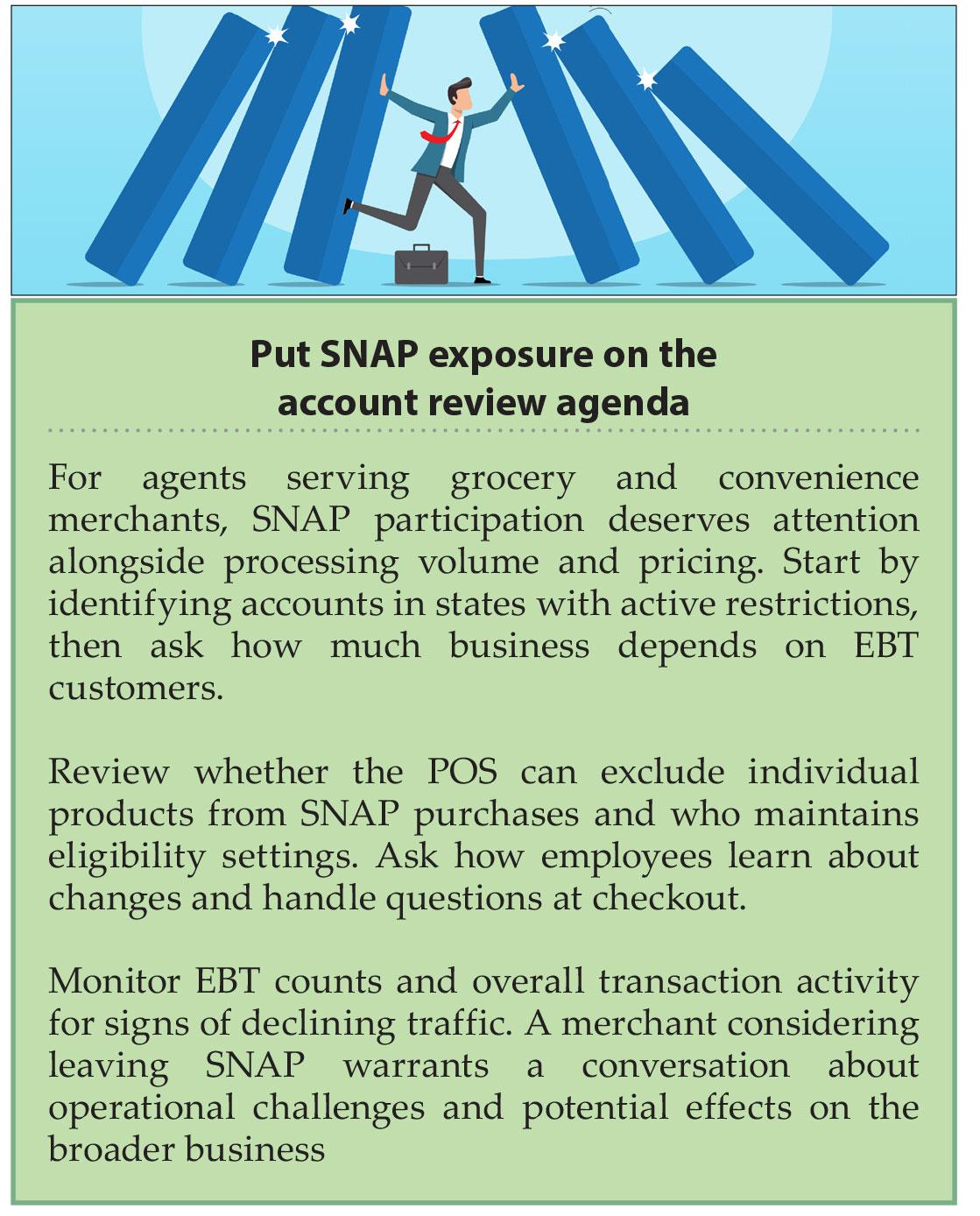
Map the portfolio. Sort merchants by state and flag every account in an active waiver state. Pay closest attention to grocery, convenience and corner stores where EBT makes up a large share of sales. Ask about the register. Confirm that each flagged merchant can mark individual items as SNAP-ineligible and knows who updates those settings when a state changes its list. A merchant who lets restricted items go through on EBT is one test purchase away from a violation.
Track the courts. Rulings have already erased waivers in five states, and the legal fight is ongoing. An agent who calls a merchant the week a rule changes earns trust that a rate cut cannot buy. Watch for early warning signs. A drop in EBT transaction counts, a sudden decline in ticket volume, or a merchant asking about leaving SNAP all point to an account at risk.
Retention starts with compliance
Price competition gets most of the attention in merchant retention. For EBT-heavy merchants, state policy now poses a serious threat to the relationship. The agent who helps a merchant stay authorized protects the store's traffic, the owner's livelihood and the residual stream that depends on both. Note: Further information about data provided in this article can be found at the following links to sources: tinyurl.com/yraa5u8k, tinyurl.com/38e8eckt, tinyurl.com/352zn63r, tinyurl.com/4tu5ktxv and tinyurl.com/47av8tfp. 
Elie Y. Katz is founder, president and CEO at National Retail Solutions (NRS), https://nrsplus.com. Contact him by phone at 201-715-5179 or by email at ekatz@nrsplus.com.
Notice to readers: These are archived articles. Contact information, links and other details may be out of date. We regret any inconvenience.
