




The Green Sheet Online Edition
October 12, 2026 • 26:10:01
BOI reporting ends for U.S. companies, merchant underwriting remains
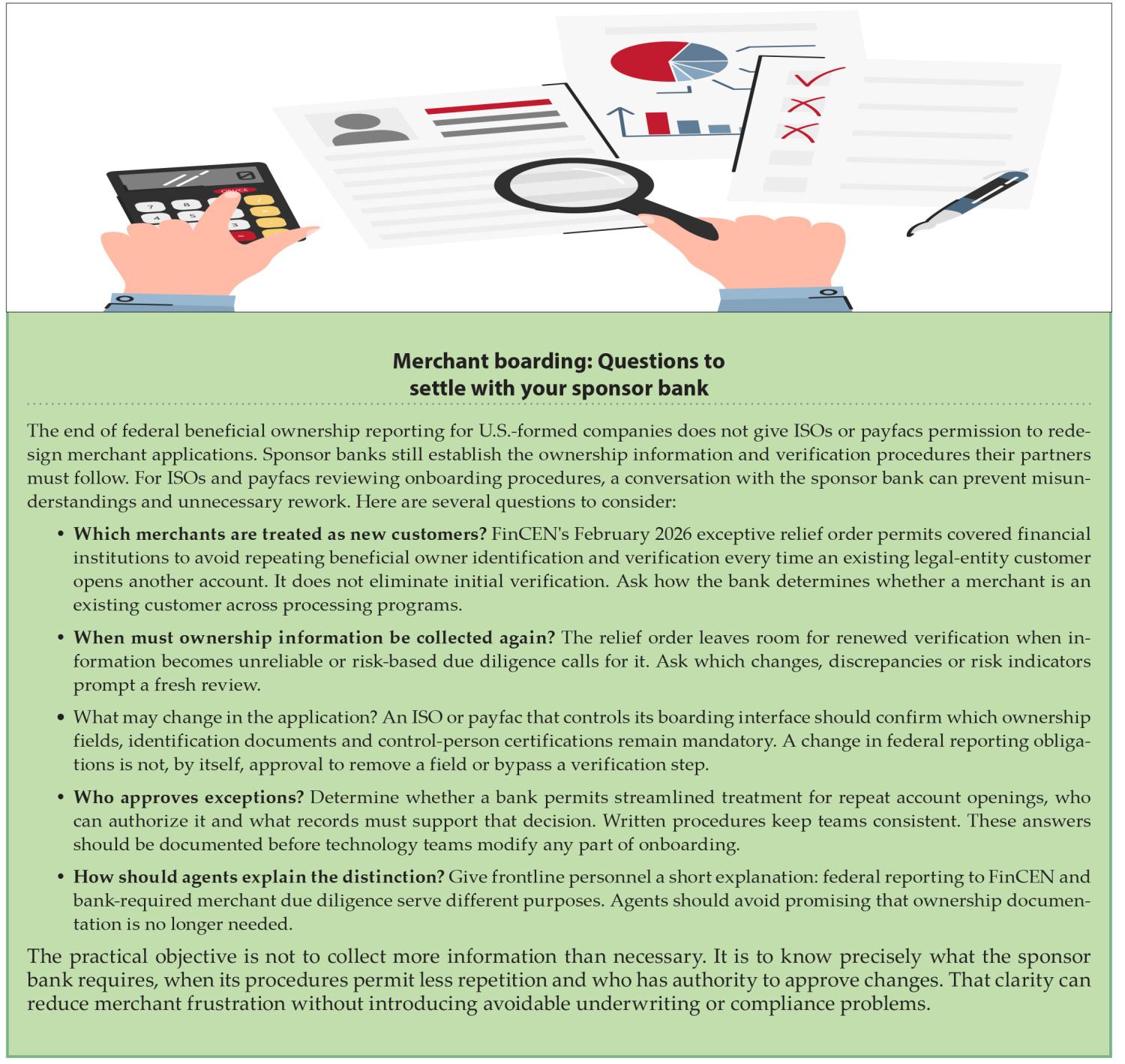
A merchant sees the headline that beneficial ownership reporting is over and asks the agent sitting across the desk why the application still wants ownership percentages and a copy of an owner's driver's license. That question is about to become a regular part of boarding conversations, and the honest answer is more nuanced than "the rule went away." Treasury and FinCEN did just permanently end one federal reporting requirement, but merchant boarding runs on a separate rulebook that this rollback doesn't touch. What actually changed On August 11, 2026, FinCEN finalized a rule permanently exempting domestic companies and U.S. persons from beneficial ownership information (BOI) reporting under the Corporate Transparency Act (CTA), the 2021 law that required most U.S. companies to disclose their owners to a federal registry.
The exemption itself isn't new: after court challenges and shifting injunctions created more than a year of uncertainty over whether the CTA could be enforced at all, FinCEN first exempted domestic companies from BOI reporting through an interim final rule in March 2025. The latest action makes that exemption permanent rather than reversible at the next administration's discretion.
Foreign entities registered to do business in a U.S. state remain subject to reporting, but only for their non-U.S. beneficial owners. That's the whole change. No U.S.-formed company or U.S. person has to file a BOI report with FinCEN, full stop. What it doesn't do is touch the paperwork a merchant fills out to open a processing account.
Two different rules asking similar questions
The CTA created a federal registry at FinCEN. Merchant boarding runs on a different, older framework: the Customer Due Diligence (CDD) Rule at 31 C.F.R. § 1010.230, which requires "covered financial institutions," federally regulated banks and credit unions, mutual funds, broker-dealers, and certain commodities firms, to identify and verify beneficial owners of their legal-entity customers. Sponsor banks and acquirers fall inside that definition. ISOs and payfacs generally do not.
Instead, ISOs and payfacs collect ownership information because a sponsor bank's contract and risk program require it, and because card network rules expect it, not because the CDD Rule applies to them directly. The distinction matters for who ultimately controls the requirement: your sponsor bank's compliance department, not FinCEN's registry rules.
FinCEN's August 11 rule doesn't amend the CDD Rule at all, and it doesn't automatically remove beneficial-ownership questions from merchant onboarding. Whether a specific field disappears from your boarding flow depends on your sponsor bank's own procedures, not on what happened to the CTA.
The qualification worth knowing
There is one genuine CDD-side change this year, and it predates the CTA final rule. On Feb. 13, 2026, FinCEN issued an exceptive relief order (FIN-2026-R001) freeing covered financial institutions from having to re-identify and re-verify a legal entity customer's beneficial owners every time that customer opens a new account. Under the order, a covered institution can limit that identification and verification to three circumstances: the first account a legal entity opens, any point where facts call the reliability of previously collected information into question, or whenever the institution's own risk-based ongoing due diligence procedures call for it. A bank can still choose to keep a stricter process; the order sets a floor, not a mandate.
That's a meaningful difference from the CTA rollback, and it's easy to conflate the two in conversation. The CTA change affects whether a company reports to FinCEN. The February order affects how often a bank has to re-collect ownership information from a customer it already has on file. If a merchant is opening a second or third account with a processor they've already boarded, that repeat-collection step may now be lighter depending on the sponsor bank's policy. A brand-new merchant relationship isn't affected by that order at all; first-time collection still applies.
Where this shows up operationally
For ISOs, payfacs and agents, these distinctions matter in three situations:
- Talking to merchants: When a merchant raises this, agents need a short, accurate answer, not two regulatory citations. Something like: "The federal government stopped keeping its own registry of company owners, but your bank still has to verify who owns this business before it can open the account, that's a separate requirement your bank sets, not something FinCEN controls anymore." That holds up regardless of which sponsor bank the merchant ends up with.
- Foreign-formed entities in your own structure: This shows up more often than you'd expect: a payfac backed by a foreign private equity fund, an ISO with a Canadian- or UK-incorporated holding company somewhere in its ownership chain, or an affiliate entity used to run a specific program that was formed abroad.
If your ISO, payfac, or an affiliate or investor vehicle anywhere in that structure was formed outside the United States and registered to do business here, it's still a "reporting company" under the narrowed rule, even though it no longer has to disclose U.S.-person owners. Don't assume the exemption reaches every entity in your structure; confirm it with counsel entity by entity.
- Your boarding flow: This one is for registered ISOs and payfacs that control their own boarding application, not agents working off a template they don't own. Don't strip beneficial-ownership fields, ID collection or control-person certifications because of the August 11 rule.
Check with your sponsor bank first. Ask directly whether their CDD procedures have changed as a result of the February exceptive relief order, and if so, for which categories of merchant, first-time versus repeat account openings, this applies. The answer will vary by sponsor bank, and a change made without that confirmation risks an underwriting exception or a compliance finding that lands back on you.
The BOI rollback changes what companies report to the federal government. It doesn't automatically change what a sponsor bank collects from a merchant at boarding. Where boarding actually gets lighter is the February exceptive relief order, and even that only reduces repeat verification for existing legal-entity customers, at the sponsor bank's discretion. Treat the CTA news as a talking point for merchant conversations and a prompt to check your own entity structure, not as a reason to touch your KYC workflow. The paperwork changes when your sponsor bank's policy changes, not before. 
Wesley Williams Esq. is a California-licensed attorney and senior associate attorney at Global Legal Law Firm, where he focuses on contracts and transactions for payment facilitators, merchants of record, ISOs, and merchants navigating the payments ecosystem. He also maintains an independent legal practice spanning fintech and payments, digital assets and stablecoin regulation, gaming law, and commercial/SaaS contracts. Contact him at wwilliams@attorneygl.com.
Notice to readers: These are archived articles. Contact information, links and other details may be out of date. We regret any inconvenience.
