




The Green Sheet Online Edition
July 13, 2026 • 26:07:01
SoftPOS versus traditional POS: performance, costs, limitations
For a long time, acquiring was a hardware-driven business. Some time ago, the most avant-garde banks and their partners began to implement SoftPOS solutions, while many were watching what would come of it.
It was a new phenomenon, a disruptive technology, which, in fact, broke the existing system. Nonetheless, skepticism about how the buyer is treated, to whom they give the phone to accept the payment, still exists.
But over the past years, with the rise of SoftPOS (tap-to-phone), something started to shift. Solutions have shown that, technically, you don't actually need a separate device to safely accept payments. The more interesting question now is where SoftPOS solutions actually make more sense than a traditional POS—and where they do not.
It's no longer just about acquiring
From a merchant's perspective, the goal is to accept as many payment methods as possible with minimal cost and complexity. And that's where things get more complicated. Today, the payments landscape is fragmented. Alongside banks, you have fintech companies, alternative payment providers, and in many countries even government-backed payment methods like QR-based systems.
Fintech companies and other alternative payment providers do not fit neatly into the traditional banking model, yet they have become essential parts of today's payments ecosystem. In reality, a merchant often has to work with several providers at once for functions like opening accounts, integrating different solutions and managing multiple flows. In theory, you could get everything from a single bank. In practice, that's rarely the case. This is where SoftPOS starts to play a slightly different role. It becomes not just a payment acceptance tool but a lightweight layer that can help consolidate different payment methods in one place.
For banks and payment providers, this shift also opens up new opportunities on the acquiring side. SoftPOS lowers the cost and complexity of onboarding merchants, which makes it more feasible to serve segments that were previously less attractive—such as micro-businesses, mobile vendors and small merchants with low transaction volumes.
Instead of investing in hardware distribution and maintenance, providers can scale merchant acquisition through software distribution, significantly expanding their reach into the long tail of the market.
This evolution also aligns with broader trends such as open banking and multi-banking, where merchants increasingly rely on networks of specialized providers rather than a single institution.
Mobile-first and embedded payments
User expectations have also changed. In digital channels, payments are already frictionless. You tap and authenticate, and it's done. No redirects, no manual input, no unnecessary steps. Offline is slowly moving in the same direction.
SoftPOS fits into this shift quite naturally, because it allows payments to be embedded directly into business tools. Instead of having one system for operations and another for payments, everything can be combined.
A simple example is an insurance incident case processing. As an insurance company customer, you can easily use a mobile application to report an incident and securely collect an insurance payout by tapping a payment card on your smartphone. No switching between apps, no separate terminal.
It may sound like a small improvement, but in day-to-day operations it removes a lot of friction. Technically, this is usually implemented through SDKs or app-to-app integrations. But conceptually, the change is bigger: payment becomes part of the workflow, not a separate step.
SoftPOS is moving beyond merchants
Another shift still early, but noticeable, is that SoftPOS is no longer limited to merchant use cases. Initially, it was strictly about acceptance. The merchant had the device; the customer paid. Now, similar technology is being explored on the customer side as well.
For example:
- Activating an e‑wallet by provisioning a payment card via tap‑to‑phone
- Confirming an action (tap-to-confirm)
- Adding an extra layer of authentication
The idea is simple. A physical card plus a PIN is still a stronger authentication factor than just login credentials. SoftPOS makes it possible to use that factor directly on a mobile device. This opens up new use cases; even P2P scenarios can evolve in this direction.
Analytics and loyalty: possible, but not always simple
In many cases, different payment methods are still handled by different systems. As a result, data is fragmented as well. Instead of one clear picture, merchants get partial insights. Loyalty has a similar structure. There is one layer provided by banks or acquiring partners—cash-back programs, bonuses and so on. And there is another layer on the merchant side.
Especially for small businesses, there is growing interest in tools that allow them to manage their own customer relationships. The challenge is the same: without consolidation, it's difficult to build something consistent. Where consolidation exists, SoftPOS can support both analytics and loyalty quite effectively.
For example, SoftPOS platforms can be connected to dashboards that track transaction volumes, average ticket size, peak hours and customer behavior patterns. When integrated with CRM systems, payment data can be linked to customer profiles, enabling segmentation and personalized offers.
Some implementations also support campaign tools that trigger targeted promotions based on purchase history or frequency. These capabilities are most effective when SoftPOS is part of a broader, unified platform; otherwise, the lack of centralized data limits how much insight can be derived.
Where traditional POS still makes sense
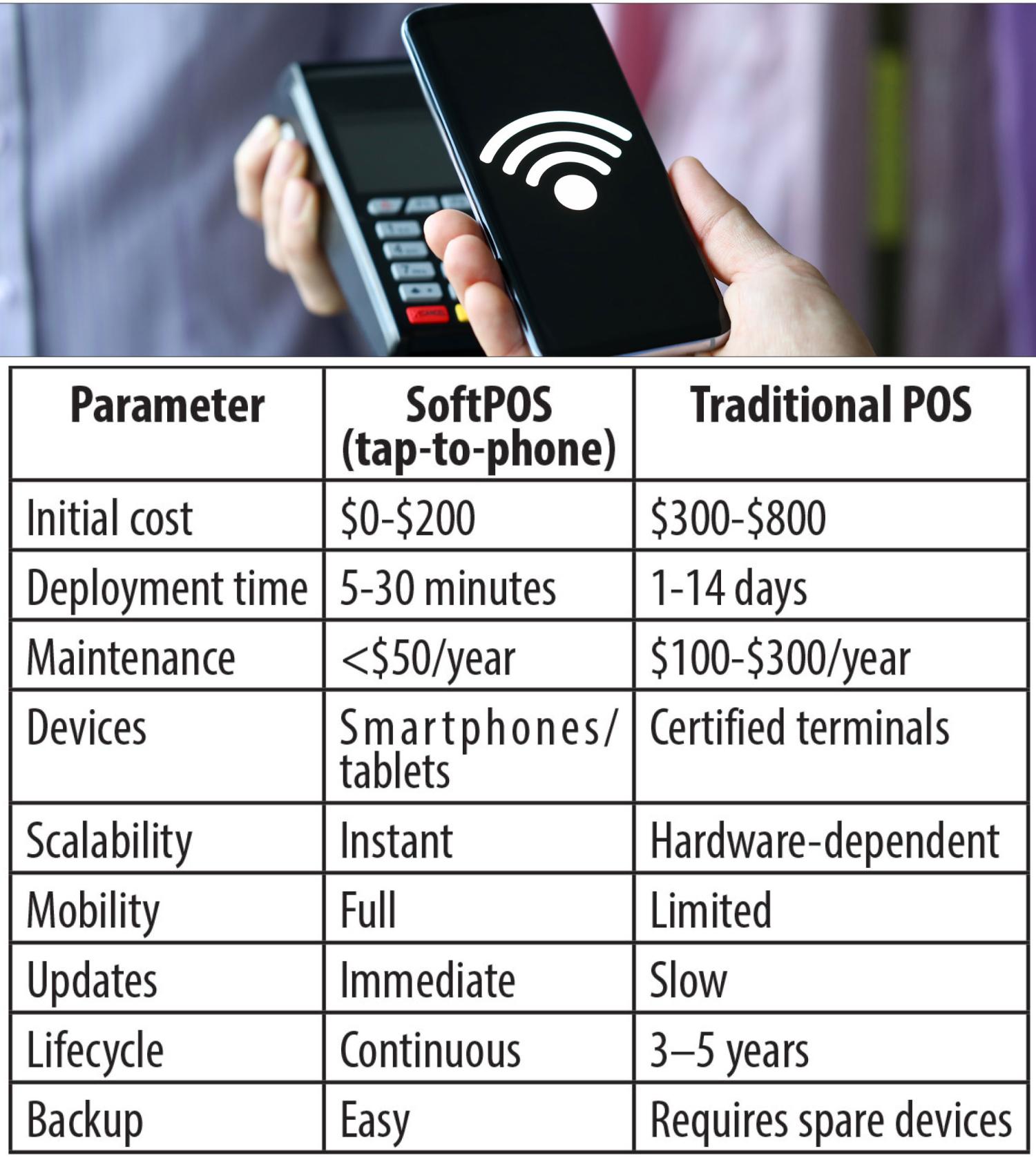
Despite all the advantages of SoftPOS, traditional POS terminals are not going away. High-volume environments are one example. In places where thousands of transactions are processed under stable conditions, dedicated terminals remain predictable and reliable.
Regulatory factors are another consideration. In some markets, merchants are required to provide physical receipts. Once you introduce printers and additional devices, the simplicity of SoftPOS becomes less obvious. For many users, a physical terminal still feels more familiar and trustworthy. Where SoftPOS clearly wins At the same time, there are areas where SoftPOS already has a clear advantage. SoftPOS is:
Much easier to deploy. In many cases, a merchant can start accepting payments within minutes. Easier to scale. If more acceptance points are needed, you simply add more devices. Easier to replace. If something goes wrong, another smartphone can be used immediately.
These differences become especially visible in dynamic environments such as seasonal businesses, delivery services or situations where demand changes quickly.
What determines long-term adoption
Whether SoftPOS becomes a long-term payment solution depends on several practical factors rather than a single decision point. Transaction volume is one of the key considerations: high-throughput environments with stable, predictable operations may still favor traditional POS terminals.
Environmental stability also matters. Businesses operating in fixed locations with consistent workflows tend to prioritize reliability and standardized setups, while mobile or distributed operations benefit more from SoftPOS flexibility.
Compliance requirements play an important role as well, particularly in markets with strict fiscalization rules or mandatory receipt issuance. In such cases, additional hardware or hybrid configurations may be required, which can influence the overall architecture.
Finally, the maturity of a company's IT ecosystem and its ability to manage mobile devices at scale can determine how effectively SoftPOS is adopted. Organizations with integrated platforms, centralized management, and strong support for APIs and SDKs are better positioned to make SoftPOS part of their long-term infrastructure rather than a temporary workaround.
Innovation favors general-purpose devices
One factor shaping SoftPOS adoption is the underlying technology ecosystem. Traditional payment terminals are produced by a relatively small group of specialized hardware manufacturers, while smartphones and tablets are developed in a much larger, highly competitive global market.
As mobile devices become faster, more secure and more capable, SoftPOS benefits automatically—without requiring purpose-built payment hardware. Greater competition also drives innovation and lowers costs.
Traditional POS terminals will continue to play an important role, particularly in high-volume or highly regulated environments. But because they depend on specialized hardware, they evolve more slowly, likely shifting the balance toward software-based payment acceptance over time.
SoftPOS versus traditional POS: comparison (See attached table)
Traditional terminals still have their place, especially in stable, high-volume environments. But SoftPOS is gradually expanding beyond its original role. For many merchants, the question is no longer whether SoftPOS can replace traditional terminals, but which combination of software and hardware best supports their business.
Vadzim Smatrayeu, vice president FinTech Services at IBA Group, is an experienced technical director whose track record includes leading fintech and information technology services initiatives. His areas of expertise include payments, contactless technologies, SoftPOS, traditional POS systems, fare collection systems, Java and ATM technologies. Contact him at linkedin.com/in/vadzim-smatrayeu-274816a5.
Notice to readers: These are archived articles. Contact information, links and other details may be out of date. We regret any inconvenience.
