




The Green Sheet Online Edition
May 25, 2026 • 26:05:02
The payment card evolves - from transaction tool to trust anchor
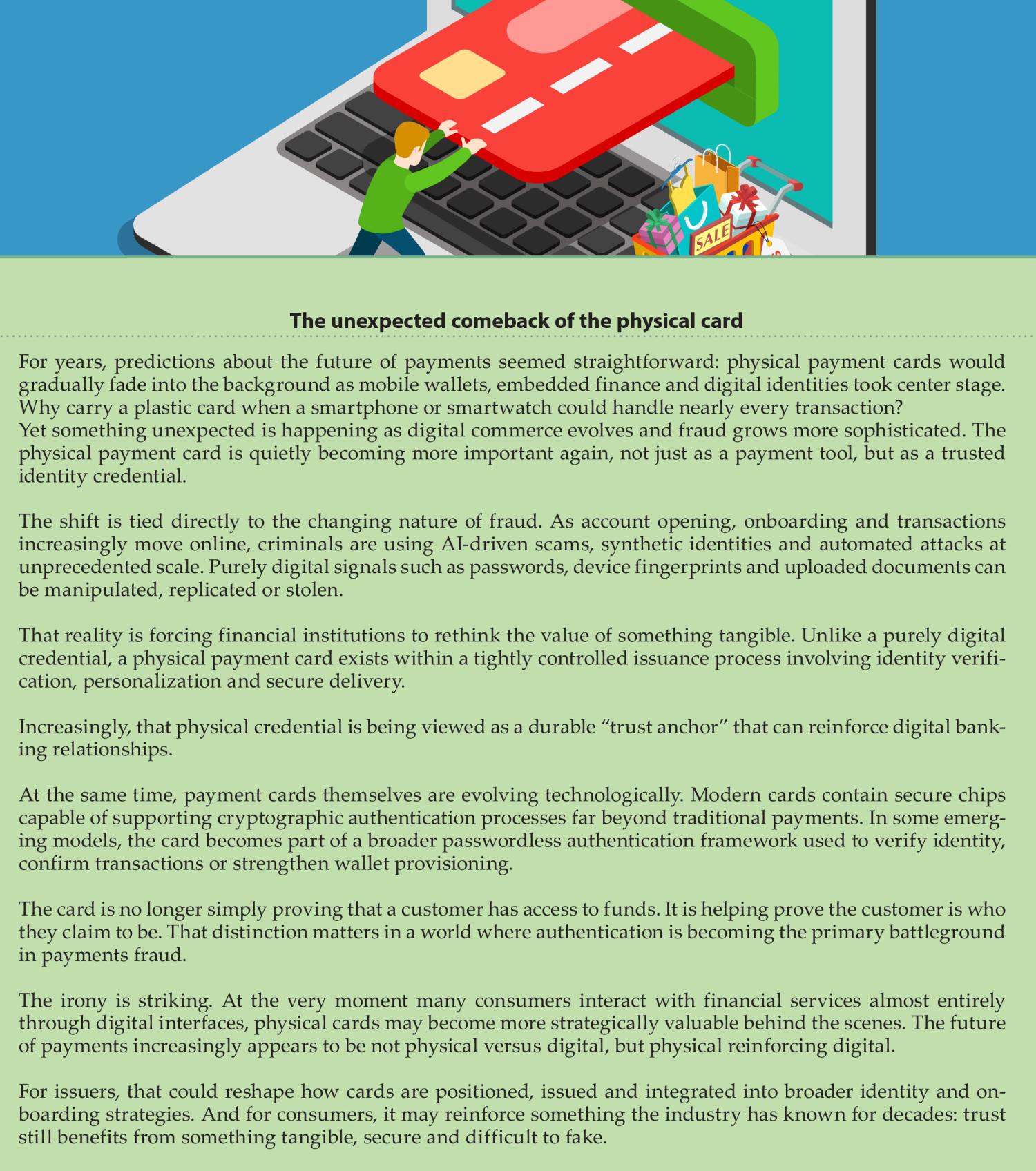
Mobile wallets, super apps, embedded finance and instant payments are used by more and more consumers. And yet, in 2026, debit and credit cards remain among the most widely used and most trusted financial instruments in the world. The reason is trust, security and convenience.
Even as consumers increasingly transact through digital interfaces, the physical card continues to serve as the foundational credential behind many of those experiences. Plus, as a transaction tool itself of course. It is often the only tangible artifact bank consumers use on a daily basis—a physical representation of a financial institution's promise of security and reliability.
Research conducted by Morning Consult on behalf of the American Bankers Association and published in October 2025 confirms that consumers continue to place greater trust in bank-issued credentials than in standalone digital identities or third-party applications (see tinyurl.com/22atkzas). That trust has been earned through decades of secure issuance processes, regulated oversight and global interoperability.
The real question facing financial institutions is no longer whether the card will survive. It is what role the card must play in an ecosystem defined by digital identity, AI-driven fraud and frictionless user expectations.
Digital onboarding and the new trust gap
Digital-first onboarding has dramatically expanded access to financial services. Accounts can now be opened in minutes, and credentials can be provisioned into wallets almost instantly. But speed has introduced a new vulnerability: risk is increasingly concentrated at account opening and during the first weeks of activity.
Industry data published by BIIA in January 2026 shows that synthetic identity fraud and AI-enabled impersonation attacks are growing rapidly, particularly during account origination and early lifecycle activity (see tinyurl.com/2ax24nux). Financial institutions are caught in a delicate balancing act. Adding digital verification layers may reduce risk, but it also increases friction and abandonment. Reducing friction, meanwhile, can unintentionally lower assurance.
Experian's most recent identity and fraud reporting highlights this tension clearly. The report notes that financial institutions are seeing growing fraud pressure during account opening and early account activity, while at the same time struggling to balance stronger verification with a seamless customer experience (see tinyurl.com/b8d4z786).
Purely digital signals—device fingerprints, behavioral analytics, document uploads—are powerful but not infallible. They can be replicated, automated and scaled by attackers using increasingly sophisticated tools.
This tension reveals a growing trust gap. What many institutions are rediscovering is that digital identity needs reinforcement from something more durable and more difficult to manipulate.
From payment instrument to authentication device
Fraud has decisively shifted online. Card-not-present transactions now account for the majority of card-related fraud losses globally, according to FICO research detailed in a company blog post by Debbie Cobb, FICO's vice president of product management (see tinyurl.com/3zcbabj5). As commerce moves into digital channels, authentication, not authorization, has become the central battleground.
Global standards bodies, such as the FIDO Alliance, have advanced phishing-resistant authentication models based on public-key cryptography. In these frameworks, private keys remain bound to the user's device, no shared secrets are stored centrally, and authentication becomes resistant to replay and man-in-the-middle attacks.
Within this architecture, the payment card itself can function as a secure authenticator. With embedded secure elements capable of supporting strong cryptographic operations, a card can enable passwordless login, secure transaction confirmation, and NFC-based as well as contact-based authentication across mobile and desktop environments.
When combined with on-device biometrics on the user's device, the result is authentication that feels frictionless to the user while materially increasing security assurance. The card is no longer only a means of initiating a transaction. It becomes a device for proving identity.
The physical card as a root credential
As virtual cards and wallets become dominant consumer interfaces, the physical card is quietly evolving into a root credential—the anchor behind digital experiences.
A card is issued only after identity verification and delivered through controlled and traceable channels. Its personalization and distribution follow strict security standards. That lifecycle creates inherent assurance advantages over credentials that exist only in software.
In practical terms, this means the card is being used not just to enable payments but to support secure account activation, first-use validation, wallet provisioning and step-up authentication for high-risk transactions. Multi-channel identity strategies that combine digital onboarding with physical credential reinforcement have been shown to significantly reduce early-life fraud exposure (see tinyurl.com/b8d4z786).
In an era dominated by software, possession matters again. A cryptographically secure object in a customer's hand can provide a layer of certainty that purely digital signals struggle to match.
The convergence of cards, wallets and identity
Historically, card issuance, wallet enablement and identity verification were managed in separate operational silos. That separation is rapidly disappearing, based on applying guidelines and regulations.
Forward-looking financial institutions are aligning card issuance directly with digital onboarding and wallet provisioning strategies. When physical and digital credentials are orchestrated as a unified system, activation accelerates, time-to-first-transaction shortens, wallet adoption improves, and fraud during early account tenure declines (see tinyurl.com/b8d4z786).
In this converged model, the card serves as connective tissue between physical and digital banking channels. It validates wallet enrollment, strengthens step-up authentication, and provides a long-lived trust anchor across devices and platforms.
As AI-driven fraud techniques grow more sophisticated, cryptographically secure, possession-based credentials are regaining strategic importance. They introduce asymmetry into the fraud equation—making attacks more complex, less scalable, and more expensive.
What cards must become throughout 2026
The future of debit and credit cards is more than a powerful and trustworthy payment tool. It is about reinforcing digital banking with durable trust.
Throughout 2026, cards are increasingly evolving into long-lived trust assets embedded within broader ecosystems. They are beginning to support passwordless and phishing-resistant authentication models, while also reinforcing onboarding processes, reducing early-life fraud exposure, and bridging the physical and digital worlds in a way that feels seamless to consumers.
The institutions that succeed in the coming years will not treat cards as physical-only means of payment. They will recognize them as strategic components of modern identity architecture.
Trust still benefits from something tangible, secure and cryptographically provable. 
Brent Bowen is the senior vice president and head of sales for financial services solutions at Giesecke+Devrient (G+D) in the United States. For more information, please visit www.gi-de.com/en/. To contact Brent, see linkedin.com/in/b-h-bowen.
Notice to readers: These are archived articles. Contact information, links and other details may be out of date. We regret any inconvenience.
