




The Green Sheet Online Edition
March 9, 2026 • 26:03:01
The AI wave hasn't broken, but undercurrents are shifting
It is increasingly evident that the AI boom has not yet burst. That said, it would be complacent to assume the path ahead will be smooth. A dramatic collapse may not be inevitable, but a pause, slowdown or uncomfortable recalibration still feels plausible. Markets rarely move in straight lines, and AI will be no exception. The key question is not when a correction might arrive, but what kind of value will endure if it does.
The dot-com era remains a useful reference point, not because today's conditions are identical, but because it illustrates how periods of rapid technological optimism tend to resolve. Companies like Pets.com gambled millions on pet-food ecommerce before consumers had fully changed habits – and disappeared quickly (see www.reddit.com/r/ValueInvesting/comments/1o4qgrg/2000_bubble_vs_2025_bubble/?utm_source=chatgpt.com).
Those solving real problems, even imperfectly at first, endured and eventually defined the next economic cycle. Amazon is a standout success story coming from humble beginnings, surviving and building a trillion-dollar giant that it is today. The same Darwinian process is at work in the AI world now.
There is, however, a notable structural difference. The AI landscape is far more concentrated than the early internet economy ever was. A small group of dominant players — such as OpenAI and Nvidia — sit at the centre. Nvidia supplies the computing power in a tightly linked ecosystem that includes OpenAI and Oracle, while many smaller startups are already struggling with product maturity and commercial traction.
The structural warning signs are real; this concentration increases systemic risk (see www.ineteconomics.org/perspectives/blog/the-ai-bubble-and-the-u-s-economy-how-long-do-hallucinations-last?utm_source=chatgpt.com). When valuations run far ahead of fundamentals in a narrow part of the stack, any slowdown can ripple outward quickly.
That does not mean the bubble has burst. It suggests the system is fragile.
The long view
One of the clearest contrasts in global AI development lies in strategic intent. Much of the Western focus has centered on individual productivity, convenience and competitive edge—think faster content creation, smarter assistants, incremental efficiency gains. These applications are not without merit, but they tend to prioritize near-term returns.
There is an argument to be made for a longer range view. The emphasis has been on how AI can be deployed at scale to improve financial flows, logistics, infrastructure and coordination across entire systems. The payoff of that approach is now becoming visible. Long-term planning compounds. Short-term optimization eventually hits constraints.
We often get told we have lost the art of cathedral thinking: the mindset that accepted a project might take generations to complete. Modern political cycles, typically four or five years, reward visible short-term wins over structural investment, and the same logic can apply in technology. An instant-gratification mindset is unlikely to produce resilient AI services, but a longer horizon might.
Regulation alone will not resolve this. Nor will simply building more powerful models. The deeper issue is what we are choosing to optimize for. Longevity, resilience and shared utility tend to deliver slower initial returns, but they also reduce the likelihood of sharp corrections. In financial services, that trade-off is well understood.
Fintech already knows what durable AI looks like
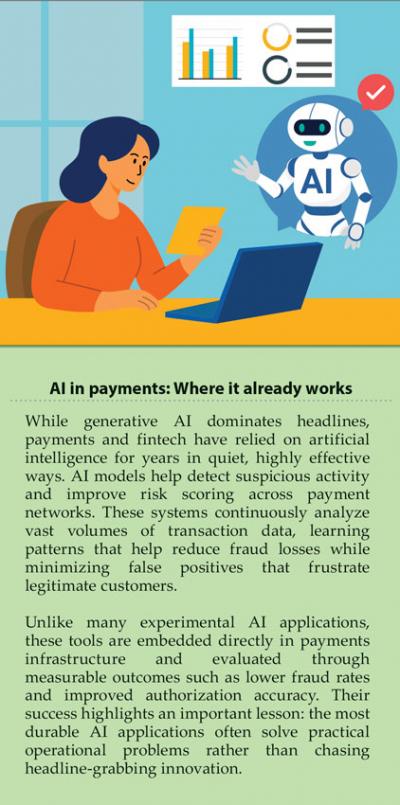
In payments and fintech, AI has been delivering value quietly for years. Fraud detection, transaction monitoring and risk scoring systems are not speculative. They are embedded, measured and continuously improved. They do not promise transformation overnight. They promise fewer false positives, lower losses and more resilient networks.
That is why the current fixation on generative AI and large language models deserves caution rather than dismissal. Some applications will prove useful. Many will not. Treating all AI as if it were synonymous with LLMs distorts investment decisions and boardroom priorities.
A widely cited figure suggests the majority of AI initiatives fail to deliver their expected returns. That failure rate is not a technology problem. It is a problem of intent, evaluation and discipline. When tools are adopted for visibility rather than utility, disappointment is the predictable outcome.
For fintech, the risk is not that AI ceases to function. It is that infrastructure-level applications become collateral damage from overpromising elsewhere.
What a lull would expose
If the market moves into a slower phase rather than a full crash, the consequences will still be meaningful. Capital will tighten. Procurement cycles will extend. Experimental deployments without a clear operational rationale will likely be cut first. That is not catastrophe; it is recalibration.
The greater risk lies in allowing that recalibration to erode trust in AI systems already performing essential work. Payments infrastructure depends on reliability. Risk management systems depend on continuity. A wave of failed vendors and inflated claims can make buyers more cautious, even toward solutions that warrant confidence.
This is where a more collective approach becomes important. Investing in resilient infrastructure, shared standards and interoperable systems may not generate headlines, but it ensures that when the hype subsides, the foundations remain solid.
$h2Bringing it back to payments
For payments, the takeaway is straightforward. Reinforcing the rails matters more than chasing novelty. Systems that reduce fraud, optimize routing and protect smaller businesses create compounding benefits across the ecosystem. They also stand the test of time.
Feathering individual nests through speculative AI deployments may deliver short-term gains. It does not create long-term stability. At scale, that approach increases the likelihood of the very bubbles the industry claims to fear.
A slowdown in AI investment does not have to be destructive. Managed with discipline, it can provide clarity. It can distinguish durable infrastructure from disposable experimentation, and long-term systems from short-term noise.
The AI bubble has not burst. But when momentum inevitably cools, the organizations that endure will not be those that chase attention. They will be those that build for longevity, not simply for launch. 
Scott Dawson, head of sales and strategic partnerships at DECTA, is a highly motivated and results oriented individual with 20 years of experience within the payments industry. Previously, he served as commercial director at Neopay. He has also held fraud management positions at PSI Holdings and Neteller, before becoming senior fraud manager and then business development manager at ClickandBuy, which was acquired by Deutsche Telekom. DECTA provides end-to-end payment infrastructure, from acquiring to issuing and processing, but unlike other players in the crowded payments marketplace the company offers bespoke-as-standard solutions aimed at making payments accessible to everyone. Contact Scott via LinkedIn at linkedin.com/in/scott-dawson-uk.
Notice to readers: These are archived articles. Contact information, links and other details may be out of date. We regret any inconvenience.
