




The Green Sheet Online Edition
January 26, 2026 • 26:01:02
Mobile wallets: Implications for merchants
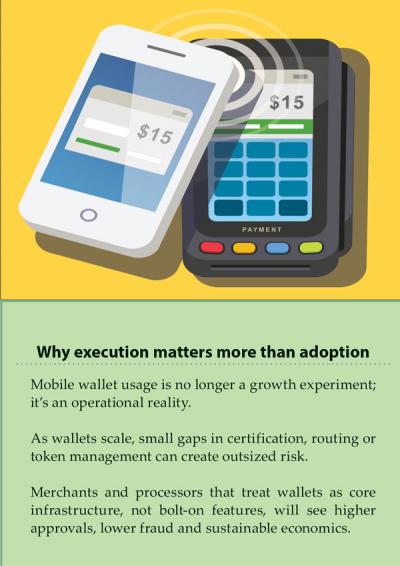
Mobile wallets are growing rapidly—and for good reason. When cards are embedded in an app or device, in-person checkout becomes tap-to-pay, reducing friction and transaction time. In-app purchases, whether online or in-store, further streamline checkout while lowering fraud rates.
Merchants that can steer customers toward app-based transactions consistently do so, increasing loyalty and reducing abandonment.
For consumers, the experience is compelling. For merchants and processors, however, the shift raises important operational, security and economic questions and requires continual maintenance. Regardless, digital wallets are no longer experimental; they are foundational.
When implemented correctly, they deliver higher approval rates, lower fraud, improved customer experience and more favorable economics. The challenge is not adoption; it is disciplined execution across security, compliance and cost optimization.
Reality gap
For years, marketers have promoted the idea of transacting "without a wallet." In practice, consumer behavior evolves more slowly. While mobile wallets reduce reliance on physical cards, they coexist with traditional wallets rather than fully replacing them.
This reality doesn't diminish the value of digital wallets; it simply reframes their role as an enhancement to existing behaviors, not a wholesale replacement.
App and browser-based wallets
Digital wallets such as Apple Pay, Google Wallet and supported wearables embed secure elements (or host card emulation equivalents) within the operating system.
When a card is enrolled, the issuer verifies the customer and provisions an EMV network token that replaces the primary account number.
That token is then used for both tap-to-pay transactions and in-app or browser-based checkout.
The card networks have extended this model to browser-based payments through EMVCo's Secure Remote Commerce (SRC) standards. SRC wallets securely store credentials and eliminate the need for passwords while enabling:
- Stronger security via tokenization, dynamic data, and 3-D Secure
- SConsistent checkout experiences across merchants and devices
- SInteroperability through a common industry standard
- SHigher approval rates and reduced cart abandonment
Platform wallets and vertical use cases
Large platforms such as Uber, Lyft, PayPal and Amazon recognized early that migrating customers to tokenized wallet credentials improves authorization rates and, in many cases, lowers interchange costs.
Issuer-provided and custodial wallets also exist, often serving niche or closed-loop environments such as stadiums, campuses or regulated verticals like cannabis.
Across these models, funding sources now extend beyond credit and debit to include ACH, BNPL and stored value, expanding choice while increasing complexity for merchants and processors.
Trust, but verify
Despite advances in in-app security, tap-to-pay remains essential for card-present wallet transactions. As adoption increases, so does the importance of device integrity and proper EMV certification.
While not getting too far into the weeds, what occurs when an NFC device, which is continually monitoring for an electromagnetic field, comes within parameters of a chip card or digital wallet, is a mating ritual of sorts.
The device and the wallet need to first establish they are compatible, complete a handshake then the card reader reads the related data, performs the verifications and risk checks before sending the authorization request to be interrogated.
In a compromised device, the authorization request may be inappropriately routed to an offline authorization request with an erroneous approval.
The takeaway is straightforward: all card-reading devices and payment flows must be fully vetted, certified and compliant with EMV specifications. Convenience should never come at the expense of control.
Bottom line
Mobile wallets are not just a new way to pay. They are a structural shift in how trust, identity and authorization are delivered at scale. The use case must be considered with every payment offering. 
As founder of Humboldt Merchant Services, co-founder of Eureka Payments, and a former executive for such payments innovators as WePay, a division of JPMorgan Chase, Ken Musante has experience in all aspects of successful ISO building. He currently provides consulting services and expert witness testimony as founder of Napa Payments and Consulting, www.napapaymentsandconsulting.com. Contact him at kenm@napapaymentsandconsulting.com, 707-601-7656 or www.linkedin.com/in/ken-musante-us.
Notice to readers: These are archived articles. Contact information, links and other details may be out of date. We regret any inconvenience.
