




The Green Sheet Online Edition
September 28, 2026 • 26:09:02
Every redirect is a revenue leak
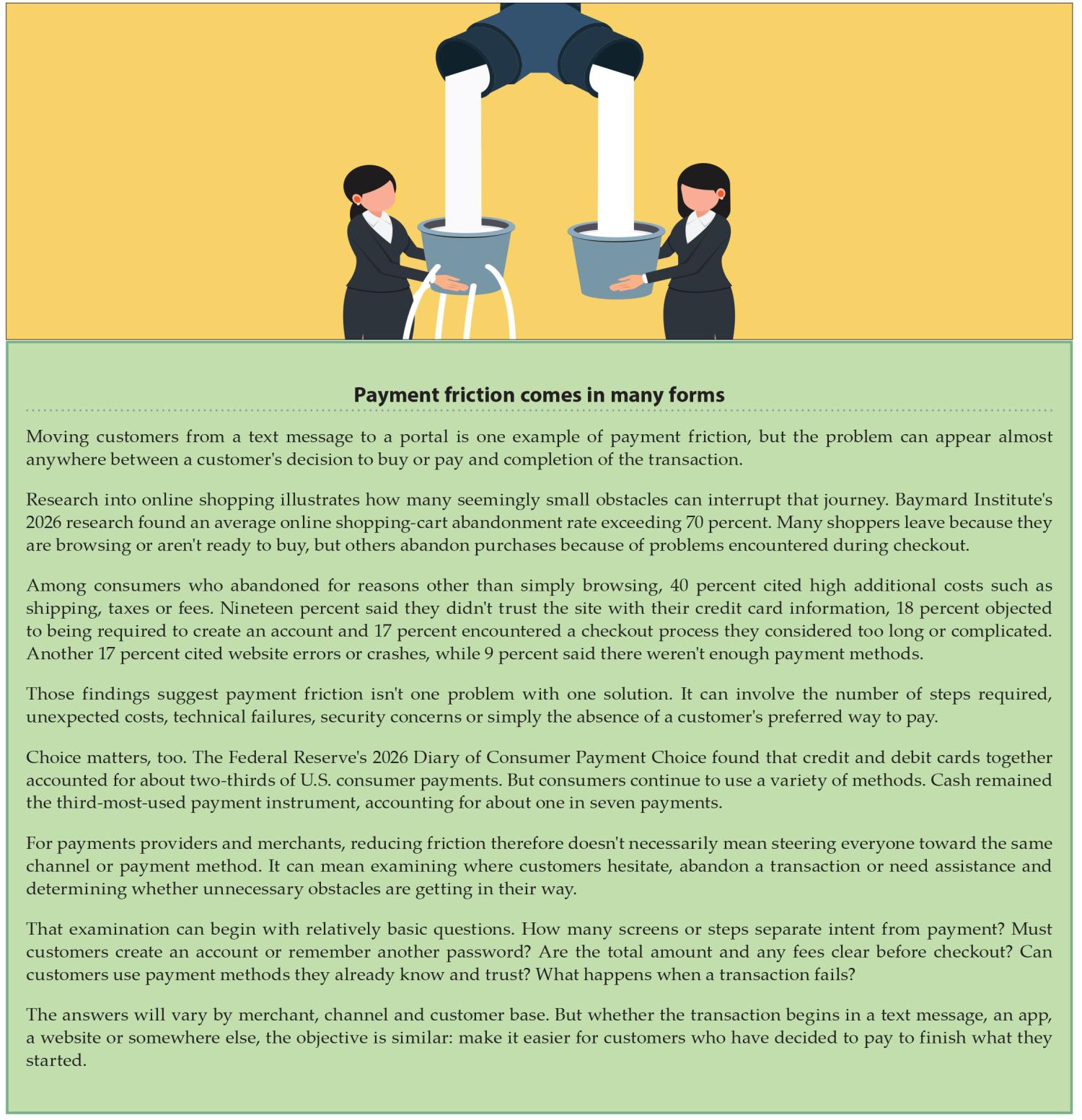
Water is relentless. Give even the smallest leak enough time, and it will grow from a drip to a flood. Payment leaks can work the same way: a little friction after a customer decides to pay may not look like much, but for anyone in the payments ecosystem—billers, lenders and the providers who serve them—the thousands of reminders, redirects and logins can add up to lost revenue.
Research from Datos Insights shows that most bill-paying consumers with cell phones are interested in pay-in-text solutions—66 percent of all consumers surveyed said they are somewhat likely to pay by text, and that jumped to 88 percent for Gen Z and millennials (see tinyurl.com/yw6d2xvn).
But the standard customer experience is still from message to portal to login to "find your bill" to, if the customer is still engaged, completing the transaction. Each extra step in that journey is another opportunity for the transaction to be abandoned. The issue extends well beyond bill payment.
Baymard Institute, which tracks online shopping behavior, puts the average shopping-cart abandonment rate at more than 70 percent. Some of that abandonment is inevitable because consumers are browsing or comparing prices, but checkout friction also plays a role.
Baymard's 2026 research found that 17 percent of U.S. online shoppers had abandoned an order because the checkout process was too long or complicated, while 18 percent had abandoned because they were required to create an account.
The lesson for payments is straightforward: getting a customer to decide to pay does not guarantee that the payment will be completed.
Closing the gap
For years, the industry has poured investment into adding new rails, faster funding options and more ways to accept a card number, but the last mile of the journey can remain stitched together from separate messaging, portal and payment systems.
That architecture often assumes the portal or app is the primary payment environment. Messaging serves mainly as a way to direct customers there, even as consumer behavior has shifted toward mobile-first interactions and quick responses to messages. Every time a customer has to jump channels to complete a payment, another step is added between intent and completion.
If the last mile is where the structure breaks down, one approach is to reduce the number of places customers must go after deciding to pay. Messaging-native payments can shorten that distance by allowing a customer to receive a secure, timely message, see the amount due and available options and complete the payment by card, ACH or digital wallet without navigating separately to a portal.
In my experience, consumers respond quickly when you remove friction and give them a payment method they already trust. People don't want more steps or more places to log in. They just want to complete the action and get it off their to-do list.
But messaging-native payments should not be confused with placing a generic link in a text that simply sends a customer to an Apple Pay- or Google Pay-supported portal. If the customer still must navigate, authenticate or search for the appropriate bill, many of the same points of friction remain. A messaging-native payment flow instead seeks to contain more of those steps within a single journey so the customer can act without an unnecessary handoff.
Text as a last-mile payment channel
Viewed this way, text can serve as more than a payment reminder; it can also provide a last-mile channel for completing the transaction. It reaches consumers on devices they use throughout the day and can provide a direct path from notification to payment.
That reach comes with guardrails. Consent, verification and regulatory oversight make text a highly governed environment. Reaching the appropriate consumer on a trusted device, presenting a compliant call to action and enabling payment within the same flow can reduce some of the friction associated with moving customers between channels. For billers, lenders and payments providers evaluating this approach, relevant measures include response rates, time to resolution, cost per transaction and the percentage of customers who complete payments after receiving a message. The objective is not simply to generate more messages, but to determine whether reducing steps produces more completed transactions.
Applications in regulated environments
The issue becomes particularly important in collections, utilities and consumer finance, where outreach is closely regulated and timely payment can have significant consequences for both businesses and consumers.
In one utility test I observed, moving from a legacy messaging setup to a compliant text workflow increased collections approximately 24-fold among a group of customers previously unresponsive to outreach attempts.
Text-based payment flows are also being used in financial services and collections alongside traditional outreach methods such as letters and phone calls. For providers using these systems, the important questions include not only how many customers respond, but whether accounts are resolved earlier, collection costs decline and customers can complete transactions without unnecessary steps.
Results in highly regulated environments also illustrate why the design of the payment journey matters. A communication channel by itself does not eliminate payment friction. The value depends on what happens after the customer receives the message and how many barriers remain between that moment and completion of the transaction.
A bit ironic, isn't it? A messaging channel doesn't necessarily solve a messaging issue. Instead, it can bridge the last mile between customer intent and completed payment. For payments providers and their clients, the larger question is not simply how to reach customers, but how easily customers can act once they receive that outreach. Reducing the steps between the decision to pay and the completed transaction may be where messaging has its greatest value. 
Shawn Curtis is vice president and general manager of payments at Solutions by Text, a company focused on building customer relationships with compliance-first messaging and integrated text payments. Before joining SBT, Curtis spent more than six years at Spreedly, where his work included helping companies modernize and scale their payments ecosystems. Contact Shawn via LinkedIn at www.linkedin.com/in/shawncurtis/. , and learn more about Solutions by Text at solutionsbytext.com.
Notice to readers: These are archived articles. Contact information, links and other details may be out of date. We regret any inconvenience.
