


Page 36 - gs260902
P. 36
Insights and Expertise


        Cash, trust and                                         are nearly instantaneous, and consumers can complete
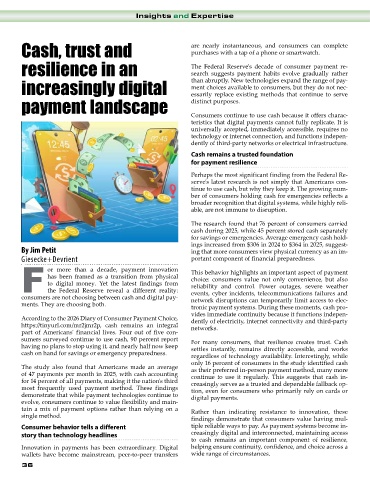
                                                                purchases with a tap of a phone or smartwatch.
        resilience in an                                        The Federal Reserve's  decade  of consumer  payment  re-

                                                                search suggests payment habits evolve gradually rather
        increasingly digital                                    than abruptly. New technologies expand the range of pay-
                                                                ment choices available to consumers, but they do not nec-
                                                                essarily replace existing methods that continue to serve
        payment landscape                                       distinct purposes.


                                                                Consumers continue to use cash because it offers charac-
                                                                teristics that digital payments cannot fully replicate. It is
                                                                universally accepted, immediately accessible, requires no
                                                                technology or internet connection, and functions indepen-
                                                                dently of third-party networks or electrical infrastructure.
                                                                Cash remains a trusted foundation
                                                                for payment resilience
                                                                Perhaps the most significant finding from the Federal Re-
                                                                serve's latest research is not simply that Americans con-
                                                                tinue to use cash, but why they keep it. The growing num-
                                                                ber of consumers holding cash for emergencies reflects a
                                                                broader recognition that digital systems, while highly reli-
                                                                able, are not immune to disruption.

                                                                The research found that 76 percent of consumers carried
                                                                cash during 2025, while 45 percent stored cash separately
                                                                for savings or emergencies. Average emergency cash hold-
                                                                ings increased from $306 in 2024 to $364 in 2025, suggest-
        By Jim Petit                                            ing that more consumers view physical currency as an im-
        Giesecke+Devrient                                       portant component of financial preparedness.

                 or  more  than  a  decade,  payment  innovation   This behavior highlights an important aspect of payment
                 has been framed as a transition from physical   choice: consumers value not only convenience, but also
                 to digital money. Yet the latest findings from   reliability and control. Power outages, severe weather
        F the Federal Reserve reveal a different reality:       events, cyber incidents, telecommunications failures and
        consumers are not choosing between cash and digital pay-  network disruptions can temporarily limit access to elec-
        ments. They are choosing both.                          tronic payment systems. During these moments, cash pro-
                                                                vides immediate continuity because it functions indepen-
        According to the 2026 Diary of Consumer Payment Choice,   dently of electricity, internet connectivity and third-party
        https://tinyurl.com/mr2jmr2p, cash remains an integral   networks.
        part of Americans' financial lives. Four out of five con-
        sumers surveyed continue to use cash, 90 percent report   For  many consumers,  that resilience  creates  trust.  Cash
        having no plans to stop using it, and nearly half now keep   settles instantly, remains directly accessible, and works
        cash on hand for savings or emergency preparedness.     regardless of technology availability. Interestingly, while
                                                                only 16 percent of consumers in the study identified cash
        The study also found that Americans made an average     as their preferred in-person payment method, many more
        of 47 payments per month in 2025, with cash accounting   continue to use it regularly. This suggests that cash in-
        for 14 percent of all payments, making it the nation's third   creasingly serves as a trusted and dependable fallback op-
        most frequently used payment method. These findings     tion, even for consumers who primarily rely on cards or
        demonstrate that while payment technologies continue to   digital payments.
        evolve, consumers continue to value flexibility and main-
        tain a mix of payment options rather than relying on a   Rather than indicating resistance to innovation, these
        single method.                                          findings demonstrate that consumers value having mul-
        Consumer behavior tells a different                     tiple reliable ways to pay. As payment systems become in-
        story than technology headlines                         creasingly digital and interconnected, maintaining access
                                                                to cash remains an important component of resilience,
        Innovation in payments has been extraordinary. Digital   helping ensure continuity, confidence, and choice across a
        wallets have become mainstream, peer-to-peer transfers   wide range of circumstances.
        36

