


Page 32 - gs260702
P. 32
Insights and Expertise


        Go-forward sale

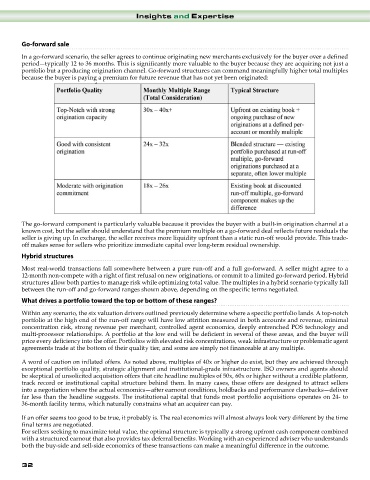
        In a go-forward scenario, the seller agrees to continue originating new merchants exclusively for the buyer over a defined
        period—typically 12 to 36 months. This is significantly more valuable to the buyer because they are acquiring not just a
        portfolio but a producing origination channel. Go-forward structures can command meaningfully higher total multiples
        because the buyer is paying a premium for future revenue that has not yet been originated:


        The go-forward component is particularly valuable because it provides the buyer with a built-in origination channel at a
        known cost, but the seller should understand that the premium multiple on a go-forward deal reflects future residuals the
        seller is giving up. In exchange, the seller receives more liquidity upfront than a static run-off would provide. This trade-
        off makes sense for sellers who prioritize immediate capital over long-term residual ownership.
        Hybrid structures
        Most real-world transactions fall somewhere between a pure run-off and a full go-forward. A seller might agree to a
        12-month non-compete with a right of first refusal on new originations, or commit to a limited go-forward period. Hybrid
        structures allow both parties to manage risk while optimizing total value. The multiples in a hybrid scenario typically fall
        between the run-off and go-forward ranges shown above, depending on the specific terms negotiated.
        What drives a portfolio toward the top or bottom of these ranges?

        Within any scenario, the six valuation drivers outlined previously determine where a specific portfolio lands. A top-notch
        portfolio at the high end of the run-off range will have low attrition measured in both accounts and revenue, minimal
        concentration risk, strong revenue per merchant, controlled agent economics, deeply entrenched POS technology and
        multi-processor relationships. A portfolio at the low end will be deficient in several of these areas, and the buyer will
        price every deficiency into the offer. Portfolios with elevated risk concentrations, weak infrastructure or problematic agent
        agreements trade at the bottom of their quality tier, and some are simply not financeable at any multiple.

        A word of caution on inflated offers. As noted above, multiples of 40x or higher do exist, but they are achieved through
        exceptional portfolio quality, strategic alignment and institutional-grade infrastructure. ISO owners and agents should
        be skeptical of unsolicited acquisition offers that cite headline multiples of 50x, 60x or higher without a credible platform,
        track record or institutional capital structure behind them. In many cases, these offers are designed to attract sellers
        into a negotiation where the actual economics—after earnout conditions, holdbacks and performance clawbacks—deliver
        far less than the headline suggests. The institutional capital that funds most portfolio acquisitions operates on 24- to
        36-month facility terms, which naturally constrains what an acquirer can pay.

        If an offer seems too good to be true, it probably is. The real economics will almost always look very different by the time
        final terms are negotiated.
        For sellers seeking to maximize total value, the optimal structure is typically a strong upfront cash component combined
        with a structured earnout that also provides tax deferral benefits. Working with an experienced adviser who understands
        both the buy-side and sell-side economics of these transactions can make a meaningful difference in the outcome.


        32

