


Page 38 - gs260602
P. 38
Insights and Expertise


        What your merchant                                      Drivers of portfolio valuation

                                                                In many cases, the concept of portfolio performance does
        services portfolio is                                   not even enter the conversation until the owner attempts
                                                                to sell or collateralize their residual for capital, and that is
        really worth – Part 1                                   when they discover, often for the first time, what buyers
                                                                and lenders actually evaluate and what truly drives the
                                                                value of what they have built.

                                                                Over two decades in the merchant acquiring industry—
                                                                involving analysis of or transactions on more than 250,000
                                                                merchant accounts—I have evaluated portfolios ranging
                                                                from pure low-risk brick-and-mortar books to high-risk
                                                                specialty processing operations. The differences in how
                                                                these portfolios are valued—often by factors of 2x to 3x—
                                                                come down to a handful of measurable characteristics that
                                                                every ISO owner should understand.

                                                                When institutional capital evaluates a merchant portfolio—
                                                                whether for acquisition, financing or investment—it
                                                                focuses on six primary factors. These are not theoretical
                                                                constructs. They are the actual criteria we apply in our
                                                                portfolio credit analysis work, drawn from real diligence
                                                                engagements.

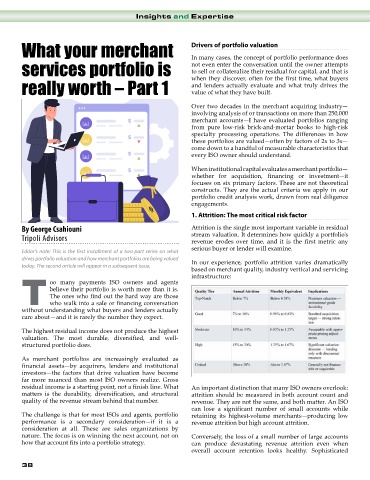
                                                                1. Attrition: The most critical risk factor
        By George Csahiouni                                     Attrition is the single most important variable in residual
        Tripoli Advisors                                        stream valuation. It determines how quickly a portfolio's
                                                                revenue erodes over time, and it is the first metric any
                                                                serious buyer or lender will examine.
        Editor's note: This is the first installment of a two-part series on what
        drives portfolio valuation and how merchant portfolios are being valued   In our experience, portfolio attrition varies dramatically
        today. The second article will appear in a subsequent issue.
                                                                based on merchant quality, industry vertical and servicing
                                                                infrastructure:
                 oo many payments ISO owners and agents
                 believe their portfolio is worth more than it is.
                 The ones who find out the hard way are those
        T who walk into a sale or financing conversation
        without understanding what buyers and lenders actually
        care about—and it is rarely the number they expect.

        The highest residual income does not produce the highest
        valuation. The most durable, diversified, and well-
        structured portfolio does.

        As merchant  portfolios  are  increasingly  evaluated  as
        financial assets—by acquirers, lenders and institutional
        investors—the factors that drive valuation have become
        far more nuanced than most ISO owners realize. Gross
        residual income is a starting point, not a finish line. What   An important distinction that many ISO owners overlook:
        matters is the durability, diversification, and structural   attrition should be measured in both account count and
        quality of the revenue stream behind that number.       revenue. They are not the same, and both matter. An ISO
                                                                can lose a significant number of small accounts while
        The challenge is that for most ISOs and agents, portfolio   retaining its highest-volume merchants—producing low
        performance is a secondary consideration—if it is a     revenue attrition but high account attrition.
        consideration at all. These are sales organizations by
        nature. The focus is on winning the next account, not on   Conversely, the loss of a small number of large accounts
        how that account fits into a portfolio strategy.        can produce devastating revenue attrition even when
                                                                overall  account  retention  looks  healthy.  Sophisticated

        38

