




The Green Sheet Online Edition
October 10, 2026 • 26:10:01
Green Sheet moves forward in a digital world
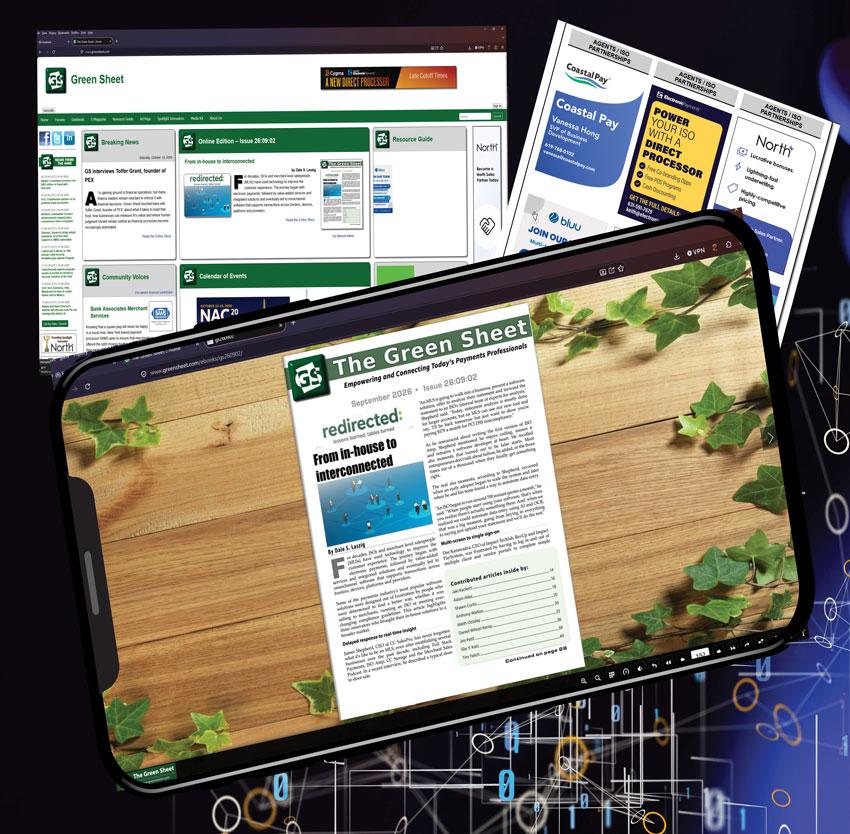
For 43 years, The Green Sheet has chronicled a paperless revolution, describing how payments industry professionals led the transition from paper receipts, checks, merchant applications and contracts to digital records.
Now, as we embark upon our 44th year, this article looks back at this prescient movement—led by ISOs and merchant level salespeople (MLSs)—and all the early and late adopters, including The Green Sheet, that became part of it.
Dispatches from earlier issues describe a steady march to a paperless future led by passionate believers.
Ecological benefits
In April 2008, Patti Murphy, our senior editor, covered the PayItGreen Alliance, a Nacha initiative designed to advance industrywide digitization. Her article, "Going green ain't always cheap," appeared in issue 08:04:02 of The Green Sheet.
"NACHA has brought together an alliance of financial services companies and billers to help educate consumers about the environmental and financial benefits of letting go of the paper in their lives and embracing electronic bills, statements and payments," Murphy wrote, adding that an alliance-commissioned study projected an annual savings of 151 million pounds of paper if one in five households went paperless.
Stuart Williams, director of payment services at CheckFree and co-chair of the PayItGreen Alliance, said, "If 20 percent of households switched to electronic bills, statements and payments, we would save enough gasoline annually to drive from New York to Los Angeles and back 918 times and preserve more than 12,000 acres of land from deforestation," citing numerous ecological benefits of managing finances electronically, including the following:
- People who pay bills online can slash at least 90 minutes a month off the time it takes to pay monthly bills (15 minutes online versus up to two hours to write out checks), according to CheckFree.
- A household with an average of 20 bills and financial statements each month can save upwards of $150 a year on postage, the cost of checks, late fees and fuel, according to NACHA.
- Most identity theft starts with someone seeing personal information on paper checks, bills or account statements, according to Javelin Strategy & Research.
Mobile, agile systems
In October 2008, contributing writer Dale Laszig described the lightness and portability of modern POS systems in "POS goes hybrid," published in issue 08:10:02.
"Consumer demand is the driving force behind technology convergence," Laszig wrote. "In a wired world, we want to stay connected with safe and reliable mobile devices. In an office environment that's increasingly virtual and paperless, we expect to log in from anywhere on the planet and e-mail proposals and contracts with a touch of the button or click of the mouse."
Laszig further noted that people are becoming more transient and don't want to lug around laptops and heavy equipment. They want to access products, services and the mobile internet from wherever they are, from the comfort and convenience of handheld screens.
"By going paperless, with online tools to help track daily activity and consolidate transactions from a variety of devices, merchants can forgo monthly statement fees, saving time and money in the process," she added.
Paperless roadmap
In June 2010, the editorial staff looked ahead to new possibilities in a cover story titled, "A roadmap to GS online," published June 28, 2010.
"Since 1983, The Green Sheet Inc. has been dedicated to the education and success of ISOs and merchant level salespeople (MLSs)," the editors wrote. "To further our mission, we have built a vibrant Web presence over the past decade. Dubbed GS Online, our website now averages more than 140,000 distinct visits and 4 million hits each month."
The Green Sheet further noted the value of publishing online where people turn for relevant breaking news, interaction in peer forums, research and professional education.
Fast forward to 2026, and payment technology has little in common with yesterday's "knuckle busters." Likewise the email newsletter our founder, Paul H. Green, sent to a group of eager sales reps bears little resemblance to the comprehensive resource our publication has become.
Technologies have come and gone. New ways to pay have emerged. ISOs and merchant level salespeople (MLSs) have transformed from sales alone to business and technology advisers. Fintechs, software developers and other new players have entered the market, while regulation, security and sophisticated fraud have added layers of complexity. Through it all, payments professionals have met each new challenge with innovative solutions and stunning speed.
The way people consume information has changed just as dramatically. And we have changed with them. In January 2025, we stopped mailing our twice-monthly print magazine and became an entirely digital publication. We retained both digital versions of the magazine—the PDF flipbook, which duplicates the layout of our print edition, and the HTML edition—while continuing to expand the news, information and resources available throughout greensheet.com.
Going digital wasn't simply a matter of replacing paper with pixels. It opened the door to doing more.
Why we made the change
For decades, the print Green Sheet was a familiar presence on desks and in briefcases throughout the payments industry. We were proud of it, and leaving print behind wasn't a decision we made casually.
But our readers were increasingly getting information online, where breaking news can be published when it happens and articles can be shared, searched and revisited without waiting for the next magazine to arrive.
The same shift was occurring among advertisers and other Green Sheet partners. Digital publishing makes it possible to connect a display ad directly with a destination, incorporate video and other media, extend campaigns through email and social channels and measure response in ways a printed page cannot.
The move therefore wasn't about doing away with something that worked. It was about putting our resources where readers and industry partners were already going—and giving ourselves room to experiment with what could come next. That experimentation continues.
Two issues a month—and more
The twice-monthly Green Sheet remains at the heart of what we do. Each issue brings together feature reporting, breaking news, expert commentary, education, legal and regulatory analysis, new products, industry developments and other resources for payments professionals.
But readers don't have to wait for publication day. Our homepage carries breaking news and Q&A interviews throughout the month, while Newswire provides a continuous stream of announcements submitted by companies across the industry. Industry Update gathers significant company developments, partnerships, appointments and milestones. Our calendar and Datebook help readers keep track of conferences, webinars and other industry events.
The site also provides access to years of Green Sheet reporting and commentary—an archive that in many ways amounts to a running history of the modern merchant acquiring industry. And there are voices here beyond our reporting staff.
Industry experts share their knowledge through The Green Sheet's contributing writers program. Community Voices connects readers with payments bloggers, podcasters and other commentators. Product profiles introduce new and enhanced technologies and services, while Innovator profiles provide another window into companies and people moving the industry forward.
New ways to connect
The Green Sheet’s digital transformation has changed how we connect with readers and extend the reach of the companies that support our magazine and platform. We continue to find new ways to bring advertisers and the payments community together and keep those relationships active throughout the publication cycle.
The objective isn't simply to put the same message in more places. Different digital channels do different jobs. Someone reading an article in a Green Sheet issue is engaging differently from someone who encounters a company through a LinkedIn post, follows an email link or searches the Resource Guide for a particular service.
That gives us and the companies we work with considerably more room to think creatively about how information reaches the right people.
Traditional advertising still has a role, but it no longer has to stand alone. Companies can combine visibility in The Green Sheet with email outreach, sponsored content, product news, videos and other digital material. Social media extends that reach further, carrying stories and company news beyond the pages of an issue and the boundaries of our website.
- Resource Guide: The Resource Guide gives advertisers dedicated Green Sheet real estate where readers can easily locate their products and services. Digital placements extend those listings across The Green Sheet website and into ongoing promotions, including recurring Breaking News, LinkedIn and Facebook features each week on Resource Guide Friday.
Rather than remaining a static directory, the Resource Guide has become an ongoing source of visibility for participating companies.
- New Products: New product stories have long been a staple of The Green Sheet. Digital distribution has given them a longer life. Each Monday, excerpts from new and recently published product stories appear in Breaking News and on LinkedIn and Facebook under the GreenShot Monday banner. The posts highlight new and enhanced solutions, accompanied by company branding and perspectives from C-suite executives and product managers.
The result is another opportunity for product news to reach readers after its initial publication.
- Email blasts: Email has created a more direct connection between advertisers and Green Sheet readers. Subscribers have opted into a variety of promotions, and Green Sheet email blasts generate average open rates of 16 percent. The program gives one advertiser at a time an opportunity to reach participating readers directly. Email blasts can be scheduled in advance and run Tuesdays, Wednesdays and Thursdays, with one advertiser featured per day.
- Spotlight Innovator: Spotlight Innovator takes digital publishing a step further by giving participating companies a private-label Green Sheet page built around an ongoing stream of content.
Each page includes a monthly lead article written or edited by a dedicated Green Sheet resource, along with links to press releases, blog posts and previously published articles about the company. Spotlight Innovator pages reside in a dedicated section of the website, with selected content also appearing in issues of The Green Sheet’s twice-monthly digital magazine.
The format gives individual stories a permanent home while creating an evolving record of a company’s news, expertise and industry perspective.
Custmized marketing
Digital publishing has also made Green Sheet marketing more flexible. Display advertising across the website and magazine can be combined with email, Resource Guide listings, sponsored content and other options based on a company’s objectives.
Campaigns are reviewed and adjusted as they progress rather than treated as one-time placements. And digital channels help extend visibility between magazine issues through a continuing mix of editorial, promotional and social touchpoints.
These options reflect a larger change in The Green Sheet itself. What began as advertising in a publication has evolved into multiple conversations taking place around it. In addition to its new format, the magazine, its readers and its industry partners have more ways to stay connected.
An old mission in a changing industry
Some things haven't changed. The Green Sheet was created to fill an information gap. Payments professionals working directly with merchants needed knowledge, training and connections in an industry that was growing faster than the resources available to help them understand it.
Today's payments professionals have access to vastly more information. Their challenge is often the opposite: sorting through an overwhelming amount of it to determine what matters, what is credible and what can help them serve merchants and build sustainable businesses.
That makes our original mission surprisingly current. We remain committed to educating, empowering and connecting the people who make payments work—ISOs and MLSs to processors, software developers, fintechs and the many specialists now participating in an increasingly interconnected industry. The tools we use to accomplish that mission will continue to change. That's the point.
Through the decades, The Green Sheet has grown from newsletter to magazine to a publication that exists across a growing collection of digital channels. We can't predict what those channels will look like several years from now. But we'll keep exploring them—and we invite you, our readers, to join in our journey.
If you're new to us, subscribe for free access to payments news, insights and industry perspectives at www.greensheet.com/forums/ucp.php?mode=register. 
Dale S. Laszig, content strategy director at The Green Sheet and founder and CEO at DSL Direct, is a payments industry journalist, creator and consultant. Connect via email at dale@greensheet.com, LinkedIn www.linkedin.com/in/dalelaszig/. Author, editor and storyteller Laura McHale Holland is editor in chief at The Green Sheet. For more than two decades, she has helped writers document the payments industry's evolution. Contact her at laura@greensheet.com
Notice to readers: These are archived articles. Contact information, links and other details may be out of date. We regret any inconvenience.
